Thursday, January 09, 2020

Annual Report 2019

Investment Returns
In Australian Dollar terms we gained 12.61% for the year and in USD terms we gained 12.16%. This is a lot less than stock markets gained, but I now prefer to compare our performance to the average hedge fund, which gained 10.35% in USD terms. The MSCI gained 27.3%  in USD terms and the ASX 200, 25.6% in AUD terms. These are the US Dollar returns month by month compared to the MSCI and HFRI indices:


We followed HFRI very tightly until September, when, apparently because of an increase in the volatility of the Australian Dollar, our performance became more volatile than the hedge fund index.
I posted equivalent Australian Dollar returns in the December monthly report. The next chart shows long term returns in Australian Dollar terms compared to the MSCI, ASX200, and the target portfolio:

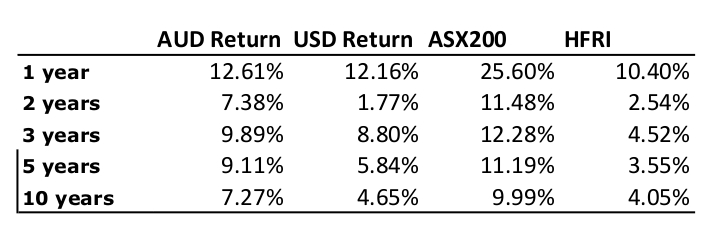
In recent years, we've followed the target portfolio quite closely. Here are annualized returns over various standard periods:

US Dollar returns are not very good over longer periods, but they still beat the HFRI, especially over the 3-5 year horizon.

Investment Allocation
The main change in allocation over the year was that we converted cash into bonds and gold and then began to run down the bond allocation mostly in favor of hedge funds:


Also, at the beginning of the year, I was still a part owner of my mother's apartment, which was then sold.

Accounts
Here are our annual accounts in Australian Dollars:


There are lots of quirks in the way I compute the accounts, which have gradually evolved over time. There is an explanation at the end of this post.

We earned $152k after tax in salary, business related refunds, medical payment refunds, tax refunds etc. We earned (pre-tax including unrealized capital gains) $251k on non-retirement account investments. The latter number was up strongly from last year. The former number continued its decline. The investment numbers benefited from the fall in the Australian Dollar ($40k in "forex" gain). Total current income was $403k. Not including mortgage interest we spent $133k. Total actual spending including mortgage interest was $147k, which was up 12.3% on last year.

$9k of the current pre-tax investment income was tax credits – we don't actually get that money so we need to deduct it to get to the change in net worth. We transferred $135k into retirement accounts from existing savings in "non-concessional (after tax) contributions. Near the end of the year we paid off the mortgage. Including mortgage payments during the year, that meant a total $520k transferred to our housing account.


The change in current net worth, was therefore -$394k. Looking at just saving from non-investment income, we dissaved $636k. Both these are crazy numbers...

The retirement account is a bit simpler. We made $46k in pre-tax contributions (after the 15% contribution tax) and made an estimated $204k in pre-tax returns. $23k in "tax credits" is an adjustment needed to get from the number I calculate as a pre-tax return to the after tax number. Taxes on returns are just estimated because all we get to see are the after tax returns. I do this exercise to make retirement and non-retirement returns comparable. Net worth of retirement accounts increased by $362k.

Finally, the housing account. I estimate that our house gained $24k in value. We spent $15k on mortgage interest. We would have paid $17k in mortgage interest if we didn't have an offset account. After counting the transfer of $520k into the housing account housing equity increased $527k of which $504k was due to paying off principal on our mortgage.

Total net worth increased by $495k, $48k of which was saving from non-investment sources. These numbers are steeply down from last year. The net worth increase last year mostly came from the inheritance.

Though our saving is down sharply on last year, we still saved in total 24% of our after tax non-investment income. Of course, this is less than last year's 33% and 2017's 54%! Including investment income our savings rate was 77%. This is based on our income calculated here at a ridiculously high $643k.

How Does This Compare to My Projection for This Year?
At the beginning of the year, I projected a gain in net worth of only $60k based on an 0% return on investments and a 6% increase in spending. As you can see, spending rose 12% and return on investments was also about 12%. As a result net worth increased by $495k. So, this was a big forecasting fail, as was last year's projection.

So, it's probably a mistake to try to make a projection for 2020 :) The baseline projection in my spreadsheet is for a 12% rate of return, a 6% increase in spending, and flat other income, leading to a $425k increase in net worth. I expect that forecast will fail big time again.

Notes to the Accounts
Current account is all non-retirement accounts and housing account income and spending. Then the other two are fairly self-explanatory. But housing spending only includes mortgage interest. Property taxes etc. are included in the current account. There is not a lot of logic to this except the "transfer to housing" is measured using the transfer from our checking account to our mortgage account. Current other income is reported after tax, while investment income is reported pre-tax. Net tax on investment income then gets subtracted from current income as our annual tax refund or extra payment gets included there. Retirement investment income gets reported pre-tax too while retirement contributions are after tax. For retirement accounts, "tax credits" is the imputed tax on investment earnings which is used to compute pre-tax earnings from the actual received amounts. For non-retirement accounts, "tax credits" are actual franking credits received on Australian dividends and the tax withheld on foreign investment income. Both of these are included in the pre-tax earning but are not actually received month to month as cash.... Finally, "core expenditure" for housing is the actual mortgage interest we paid. "Expenditure" adds back how much interest we saved by keeping money in our offset account. We include that saved interest in the current account as the earnings of that pile of cash. That virtual earning needs to be spent somewhere to balance the accounts... It is also included in the "transfer to housing". Our actual mortgage payments were less than the number reported by the $2k in saved interest. For current accounts "core expenditure" takes out business expenses that will be refunded by our employers and some one-off expenditures. This year, there are none of those one-off expenditures. "Saving" is the difference between "other income" net of transfers to other columns and spending in that column, while "change in net worth" also includes the investment income.

Thursday, January 02, 2020

December 2019 Report

This month I decided to stop short-term trading again. I think you can make money doing what I was doing, but trading at a size that makes a real difference generates too much anxiety for me. I didn't hear from HSBC on refinancing our mortgage. I sent them one email. Will need to chase them more in January.

The Australian stockmarket fell a bit in December and the Australian Dollar rose, but overseas markets rose. The Australian Dollar rose from USD 0.6764. to USD 0.7023. The MSCI World Index rose 3.56% and the S&P 500 3.02%. On the other hand, the ASX 200 lost 2.08%. All these are total returns including dividends. We gained 0.28% in Australian Dollar terms and 4.11% in US Dollar terms due to the rise in the Australian Dollar. The target portfolio is expected to have lost 0.82% in Australian Dollar terms and the HFRI hedge fund index is expected to have gained 1.07% in US Dollar terms. So, we out-performed all our benchmarks, which is rather unusual. Updating the monthly AUD returns chart:


MSCI is negative here in December because of the rise in the Australian Dollar. We haven't lost money on a monthly basis in Australian Dollar terms since November 2018...

Here is a report on the performance of investments by asset class (futures includes managed futures and futures trading):

Hedge funds and gold did very well, which is the opposite of last month. Trading detracted most from returns. The largest positive contribution to the rate of return came from hedge funds. The returns reported here are in currency neutral terms.

Things that worked well this month:
  • Hedge funds Platinum Capital/International Fund and Tribeca did very well. Tribeca (TGF.AX) is no longer our worst ever investment in dollar terms, though it is still hugely drawn down.
  • Gold did well, almost reaching this year's highs again.
What really didn't work:
  • Bitcoin lost heavily and we stopped trading it.
We moved a little bit further towards our new long-run asset allocation:


This is what the target portfolio would look like:


On a regular basis, we invest AUD 2k monthly in a set of managed funds, and there are also retirement contributions. Other moves this month:
  • USD15k of Ford bonds were called and we didn't buy any new bonds.
  • We bought AUD 40k by selling US Dollars.
  • We traded very badly...
  • We bought 500 shares of a Commonwealth Bank hybrid (CBAPI).

Sunday, December 29, 2019

New Target Portfolio Allocation

Following up on my post on the best portfolios for Australia, this post will lay out the new target portfolio allocation. The basic idea is to reduce the allocation to managed futures from 25% in my previous target portfolio to 10%. This is because I plan to do little active trading going forward and futures funds have had lacklustre performance for several years. Maybe they will come back, but we should see them more as a potential hedge than as a main asset class at this point I think.

At the top level the portfolio is 60% in stocks and 40% in other assets. The other assets are allocated equally between bonds, futures, gold, and real estate. The stocks allocation is roughly equally divided between Australian and international stocks. 10% of the portfolio is allocated to private equity and 50% to public. Then the public allocation is divided between long only and hedge fund strategies. Within the long only Australian allocation, 1/3 is devoted to small cap stocks. The full allocation is:

10% Australian large cap
5% Australian small cap
12.5% International stocks
10.75% Australian oriented hedge funds
10.75% International oriented hedge funds
10% Private equity
10% Bonds
10% Real estate
10% Gold
10% Managed futures
1% Cash

We will also usually use some leverage or gearing. 1% in cash seems sufficient given the ability to borrow.

The Best Portfolio for Australia

The portfolio charts website, I wrote about before, now lets you do analysis using Australian assets, inflation etc! It turns out that the best portfolio for Australia isn't the same as the best for the US... The following table shows the average and standard deviation of real returns, the maximum drawdown, and the safe and permanent withdrawal rates (preserves capital) for a 30 year retirement horizon:

This is based on data since 1970. Based on the permanent withdrawal rate the Ivy Portfolio developed by Meb Faber is best. The 100% Aussie stocks portfolio (TSM) has a slightly higher return, but the lowest permanent withdrawal rate. So, I think Aussie investors should start to think about portfolio design from something similar to the Ivy Portfolio. It's no surprise that I have been a fan of Meb Faber and endowment style portfolios...

Using ETFs, this portfolio recommends putting 20% into each of Australian stocks, international stocks, intermediate term bonds, commodities, and REITs.

Using the build your own portfolio tool you can see what tweaking this beginning portfolio can do. For example, replacing half the commodities allocation with gold and half the bond allocation with extra international stocks, increases the return to 6.1% and the SWR and PWR to 5.2% and 4.4% with almost no increase in drawdowns.

Going to 60% stocks divided equally between Australia and the rest of the world and 10% in each of bonds, gold, commodities, and REITs, is actually quite similar in return profile to the Ivy Portfolio. The key thing is to hedge Australian stocks with international and real assets. This latter portfolio is probably going to tbe basis of my own new target portfolio.


Thursday, December 12, 2019

Pulling the Plug on Short-Term Trading


I've decided to stop short-term trading. In recent months it hasn't made any money, it takes up a lot of time, and it gives me a lot of anxiety. Even though I am doing systematic trading I find myself looking at the market a lot and worrying about my positions. I can't seem to stop it. And my current position sizes are quite small. After a sleepless night, I've had enough. I already cancelled my orders that were waiting to execute. I will keep the existing Bitcoin and palladium positions until they exit naturally

Going forward, I will need to think about our overall financial plan again. Trend following funds aren't doing well in recent years, so we won't want to allocate that much to them compared to the current target allocation to "futures". What should we invest in instead? Should I still plan to set up an SMSF? I delayed that while I waited to see if trading was going to be a big part of it.

I've been here a couple of times before.

Friday, December 06, 2019

Trading Update

Well, that didn't last long. In November's report I said I would raise the risk allocation to palladium and soybeans. I just got stopped out of palladium futures though the contract is ending the day more or less where it began. I actually made a little money on the trade, but I'm not willing to take so much risk. So, I'm going to go back to trading palladium CFDs with a smaller amount of risk. I'll cut soybeans back to USD 2,500 risk as well. Yesterday, Bitcoin had a double stop out. First the long position was closed for a loss and a short opened and then the short was stopped out intraday. After all that, the contract ended near where it started:


I'm seriously thinking again of giving up on trading. Yes, you can make money doing this and I am now disciplined enough to always do the trades the algorithm says to do. But in practice there is still quite a lot of anxiety and mood swings. If I keep trading so small that I only make say a thousand dollars a month at it, it's not really worth the hassle. But if I make it big enough to make a difference I will have too much anxiety. That's the dilemma at this point. So far this financial year I am just losing money. I've given back all of last month's profit in the first week of this month.