Wednesday, October 23, 2019
Five Losing Bitcoin Trades in a Row
The bad news is that the worst historical losing run in Bitcoin is eleven losing trades in a row. The good news is that least we now have the losses more under control after adopting position sizing and a constant (more or less as we use rounding of contract numbers) maximum dollar risk. I am also now 100% disciplined in following the algorithms. That was a big struggle. We are now back to short again.
Without slippage the previous trade would have been a $120 win. We had a $30 loss. The last trade though was a $2,000 loss when rounded up to two contracts.
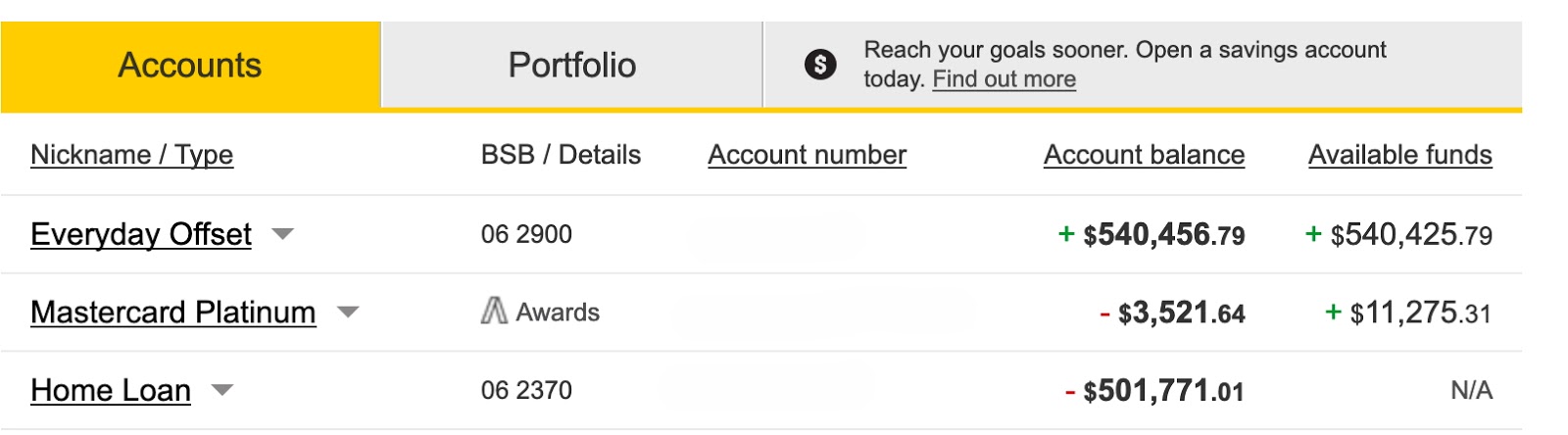
Mortgage Redrawn
Now to transfer the money to investment. This is how I account for this re-structure:
Almost all our historical savings from wages etc ("current savings") have now been converted into housing equity and extra retirement contributions. Housing equity is now a few hundred dollars short of the value of the house as I left a small amount of the mortgage unpaid in order not to potentially trigger something undesirable by totally paying it off.
Tuesday, October 22, 2019
Monday, October 21, 2019
Trading and Mortgage Inversion Update
We switched from short one contract of Bitcoin to long two this morning, booking a USD 30 loss on the short trade. We are long two as the per contract risk is lower now. After four losing Bitcoin trades, hopefully this is a winning one...
I sold a lot of shares this morning and already was allowed to move some of the proceeds to our offset account. I also paid down AUD 100k of the mortgage and was surprised to see that I could redraw it immediately. I had thought I would need to wait to 4th November for the redraw balance to update. This means that I might be able to complete the inversion this week.
P.S.
So I paid off another AUD 300k later in the day. Am still waiting on a transfer of AUD 100k from my margin loan. When I get it I should be able to complete the "inversion".
I sold a lot of shares this morning and already was allowed to move some of the proceeds to our offset account. I also paid down AUD 100k of the mortgage and was surprised to see that I could redraw it immediately. I had thought I would need to wait to 4th November for the redraw balance to update. This means that I might be able to complete the inversion this week.
P.S.
So I paid off another AUD 300k later in the day. Am still waiting on a transfer of AUD 100k from my margin loan. When I get it I should be able to complete the "inversion".
Monday, October 14, 2019
Optimizing Trading Portfolios and Shifting to Return on Risk Metric
I started exploring testing portfolios of trading strategies. For this, I decided that in looking at return on capital where capital is the face value of a futures contract doesn't make much sense. It seems to make more sense to look at the return on money at risk. It makes the most sense to measure that in dollars as a share of a total risk budget. This then leads me to making the primary measure of return also to be in dollars. Here is an optimized portfolio of Bitcoin, oil, and palladium:
The portfolio has a total risk budget of USD 5,000. This is then allocated across the three markets with the resulting profit curves. The analysis assumes that you can trade fractional futures contracts. Oil and palladium help diversify Bitcoin and increase the information ratio. Using a zero benchmark and daily returns on risk the portfolio IR is 2.96 rising from 2.17 for Bitcoin alone.
Oil hasn't gone anywhere in the last year, but did well in 2018 when Bitcoin struggled. Going forward, I will test whether each new market I look at improves the portfolio IR or not.
This approach then also leads to computing the prices for continuous futures contracts additively rather than multiplicatively – so that differences in dollars are preserved -– and to focusing on a constant risk budget in dollars. It also allowed me to simplify the back-testing program quite a bit. In the following chart the blue line is the daily profit curve for trading one contract of Bitcoin futures:
The red curve is based on completed trades only. The green curve has a constant dollar risk equal to the average of the single contract. To be more realistic I have rounded the number of contracts to the nearest whole number, which could be zero. This keeps the strategy out of the market in late 2017 and early 2018, when the single contract strategy had a big drawdown. The constant risk strategy has a higher return and a smaller maximum drawdown than trading a single contract. So, this is the strategy I am adopting for Bitcoin going forward. This morning, we switched from one contract long to one contract short...
The portfolio has a total risk budget of USD 5,000. This is then allocated across the three markets with the resulting profit curves. The analysis assumes that you can trade fractional futures contracts. Oil and palladium help diversify Bitcoin and increase the information ratio. Using a zero benchmark and daily returns on risk the portfolio IR is 2.96 rising from 2.17 for Bitcoin alone.
Oil hasn't gone anywhere in the last year, but did well in 2018 when Bitcoin struggled. Going forward, I will test whether each new market I look at improves the portfolio IR or not.
This approach then also leads to computing the prices for continuous futures contracts additively rather than multiplicatively – so that differences in dollars are preserved -– and to focusing on a constant risk budget in dollars. It also allowed me to simplify the back-testing program quite a bit. In the following chart the blue line is the daily profit curve for trading one contract of Bitcoin futures:
The red curve is based on completed trades only. The green curve has a constant dollar risk equal to the average of the single contract. To be more realistic I have rounded the number of contracts to the nearest whole number, which could be zero. This keeps the strategy out of the market in late 2017 and early 2018, when the single contract strategy had a big drawdown. The constant risk strategy has a higher return and a smaller maximum drawdown than trading a single contract. So, this is the strategy I am adopting for Bitcoin going forward. This morning, we switched from one contract long to one contract short...
Thursday, October 10, 2019
2018-19 Income and Spending Breakdown
After doing our tax returns I can now report the breakdown of income and spending for the 2018-19 financial year, following up on the breakdown for 2017-18:
On the right there is a breakdown of some of the larger categories into sub-categories. Unlike some bloggers I can't say what we spend on food, or clothes etc. I just know how much we spend at different sorts of retail outlets.
One of the biggest changes from last year is the reduction in cash spending from 13% to 3.5% as we started to use credit and debit cards more to track our spending better. Restaurants is up as former cash spending was converted to spending using cards. Other major changes are:
Income was up strongly on the previous year, mainly due to futures trading. As a result, taxes were also up strongly to over AUD 100k. OTOH total spending and saving also rose strongly. Note that "current saving" here is much higher than my usual definition of saving, which only includes saving from salaries and similar income. Here, total income includes investment income and so saving is correspondingly higher.
On the right there is a breakdown of some of the larger categories into sub-categories. Unlike some bloggers I can't say what we spend on food, or clothes etc. I just know how much we spend at different sorts of retail outlets.
One of the biggest changes from last year is the reduction in cash spending from 13% to 3.5% as we started to use credit and debit cards more to track our spending better. Restaurants is up as former cash spending was converted to spending using cards. Other major changes are:
- An increase in health spending from 7% to 16% due mainly to costs of pregnancy/childbirth.
- A major increase in housing spending from 16% to 26% as we undertook renovation work and paid more mortgage interest due to having less money in our offset account.
- A major reduction in travel from 14% to 3% as we only went on a trip to Sydney this year instead of to Europe and Japan.
Income was up strongly on the previous year, mainly due to futures trading. As a result, taxes were also up strongly to over AUD 100k. OTOH total spending and saving also rose strongly. Note that "current saving" here is much higher than my usual definition of saving, which only includes saving from salaries and similar income. Here, total income includes investment income and so saving is correspondingly higher.
Tuesday, October 08, 2019
Planning the Mortgage Inversion
I first wrote about this four years ago. I realized today that I could actually pull this off next month. At this point, I have close to AUD 300k in our bank account (which is an offset account). The mortgage is AUD 490k. If I sell some shares, which are currently in the red, like Tribeca Global Resources, realizing capital losses and transfer some Australian dollars from Interactive Brokers I can reach half a million dollars in our bank account. The amount of cash that can be redrawn is only updated on the 4th of the month, so I will wait to a little later this month to sell the shares and transfer the cash and pay off almost all the mortgage. Then in early November I will redraw the cash and transfer it to our brokers. As the mortgage is in both our names, I will transfer the money 50/50 to accounts in each of our names. After that, almost all of our mortgage interest should be tax-deductible. Of course, I could just pay off the mortgage. But the interest rate for a home equity loan is higher than for an owner occupier mortgage and am happy to have debt at relatively low interest rates and invest it in stuff that hopefully will pay a higher return.
Subscribe to:
Comments (Atom)