Tuesday, March 03, 2020

February 2020 Report

This month the whole family traveled to New Zealand for a week.This was baby Moomin's first international trip. He also started daycare two days a week. Moomintroll started going to free pre-school at the local public school 2.5 days a week and 2 days a week he is going to a private school where we can still get a childcare subsidy from the government.

It's been more than 3 months since we started trying to transfer our mortgage from Commonwealth Bank to HSBC. I went to the HSBC branch again, midmonth. The manager claimed that she had an incorrect email address for me and so I didn't get her message querying various things. They want to reduce the cash out component and the loan term length, both of which I was happy with. 

I also tried to raise our Commonwealth Bank credit card credit limit from AUD 15k to AUD 20k. I was unsuccessful :( I always think it's strange that they don't consider assets or net worth in these applications.

All stock markets fell sharply in response to the Coronavirus pandemic. The Australian Dollar fell from USD 0.6695 to USD 0.6499. The MSCI World Index fell 8.04%, the S&P 500 8.23%, and the ASX 200 7.46%. All these are total returns including dividends. We lost 3.8% in Australian Dollar terms and 6.61% in US Dollar terms. This was the worst monthly investment return ever in terms of absolute Australian Dollars lost (AUD 141k). The target portfolio lost 2.55% in Australian Dollar terms and the HFRI hedge fund index lost 1.67% in US Dollar terms. So, we under-performed these benchmarks though did better than equity indices. Updating the monthly AUD returns chart:


Here is a report on the performance of investments by asset class:


The returns reported here are in currency neutral terms.

Things that worked well this month:
  • Strangely, the China Fund was the best performer, gaining USD 4k. I sold it at the right time.
  • The TIAA Real Estate Fund rose a tiny bit for the month. Apart from those other gainers were all bonds.
  • Though it did lose money, the PSS(AP) superannuation fund was very resilient, only losing 2.1%.
What really didn't work:
  • Junkier bonds like Virgin Australia and Tupperware and even Commonwealth Bank hybrids lost big time. Baby bonds generally did OK, though.
  • Winton Global Alpha fund fell by 2.86%, providing little diversification benefit.
  • Listed hedge funds were crushed, including Pershing Square (down 8.6% for the month), Platinum Capital (-23.3%), Regal (-11.4%), Tribeca Global Resources (-33%), and Cadence Capital (-20.5%). In most cases the stock price has fallen much more than the net asset value. This chart compares the actively managed ETF, PIXX.AX and the closed end fund PMC.AX, which are invested in similar portfolios:

We moved a a bit away from our new long-run asset allocation. The shares of bonds, gold, and real estate rose and all others fell:


On a regular basis, we invest AUD 2k monthly in a set of managed funds, and there are also retirement contributions. Other moves this month:
  • We sold USD20k of Tupperware bonds and USD50k of Energy Transfer bonds and bought USD25k of Medallion Financial (MFINL) and USD25k of General Finance (GFNSL) baby bonds (i.e. 1,000 shares of each) and USD50k of Ford and USD25k of Virgin Australia bonds. USD40k of Kinder Morgan bonds matured. So, our corporate bond holdings rose by USD15k. Selling Tupperware was a good move. Buying Virgin Australia was not.
  • We also bought 500 more CBAPI.AX Commonwealth Bank hybrid securities (convertible bonds). It wasn't a good idea.
  • We bought AUD 50k by selling US Dollars.
  • We exercised our rights to buy 50,000 Pengana Private Equity (PE1.AX) shares in the rights issue. The actual transaction will come in March.
  • I Sold 2,000 China Fund (CHN) shares after they recovered from the initial coronavirus scare. I expect there to be further implications of coronavirus, though of course I could be wrong. 
  • I bought another 2,000 IAU shares (a bit less than 20 ounces of gold). 
  • I bought a net 10,000 shares in Tribeca Global Resources Fund (TGF.AX) when the price seemed particularly depressed after one of the companies they lent money to entered US Chapter 11 bankruptcy. Also, one of the two main portfolio managers quit recently. This is now our worst investment ever in terms of dollars lost. We did a tax loss harvesting sale as part of this transaction, buying back shares in our other account. Different people, so not a "wash sale". I was too early.
  • I bought 20,000 more shares of Cadence Capital (CDM.AX) another depressed LIC (listed hedge fund). Too early here too.
  • I bought 20,000 shares of US Masters Residential Property Fund (URF.AX) - an even more beaten down closed end fund. We previously held this and sold at a small loss before the price really dived.
  • I bought 4,957 shares of Platinum Capital (PMC.AX).

Friday, February 28, 2020

Asset Allocation Since October 2018

Since October 2018 when we nominally received the inheritance, the total allocated to cash, futures, gold, and bonds has remained fairly constant at 50%. There have been big shifts into bonds and to a lesser degree gold and I have bought Australian Dollars and sold US Dollars. But on net I haven't deployed money into real estate, private equity, hedge funds, and shares. Again, there has been some change in the mix of those "risk assets". Some of my bonds have also turned out to be quite risky...

Now it is looking more and more likely that there will be a recession and opportunities to buy risk assets cheaper. Though, if I really knew that I would have sold a lot of risk assets or shorted the market. So, I don't really know. Mainly I'll be watching the yield curve. The long-run target allocation to all these risk assets is around 70% and 30% in gold, bonds, and futures.

I am planning to increase purchases of Australian Dollars from AUD 10k per week to maybe AUD 15k per week in the short term.

Monday, February 03, 2020

January 2020 Report

A relatively uneventful month. Even though I went into the branch, I still have no news from HSBC on refinancing our mortgage...

The Australian stock market rose sharply in January as the Australian Dollar fell, but overseas markets fell. The Australian Dollar fell from USD 0.7023 to USD 0.6695. The MSCI World Index fell 1.08% and the S&P 500 0.04%. On the other hand, the ASX 200 gained 4.98%. All these are total returns including dividends. We gained 3.46% in Australian Dollar terms and lost 1.38% in US Dollar terms. This was the biggest monthly investment return ever in terms of absolute Australian Dollars gained (AUD 124k). The target portfolio is expected to have gained 4.00% in Australian Dollar terms and the HFRI hedge fund index lost 0.19% in US Dollar terms. So, we under-performed all our benchmarks. Updating the monthly AUD returns chart:


MSCI is positive here in January because of the fall in the Australian Dollar.

Here is a report on the performance of investments by asset class:


Gold and Australian stocks did well. The returns reported here are in currency neutral terms. Our gains in gold in Australian Dollar terms were near 10% (AUD 27k increase in value).

Things that worked well this month:
  • Gold did very well.
  • Diversified portfolios at Unisuper, PSSAP, and CFS Diversified Fund all performed well.
  • Hedge fund Regal Funds (RF1.AX).
What really didn't work:
  • Hedge funds Platinum International and Tribeca Global Resources did poorly
  • Our futures position betting on a steepening of the yield curve lost heavily as the curve moved back towards inversion.
We moved a little bit further towards our new long-run asset allocation:


On a regular basis, we invest AUD 2k monthly in a set of managed funds, and there are also retirement contributions. Other moves this month:
  • USD10k of Genworth and USD 16k of Dell bonds were called, USD 50k of Tomari bonds matured, and bought USD 25k of Ready Capital baby bonds (RCP). So, our corporate bond holdings fell by USD 51k.
  • We bought AUD 40k by selling US Dollars.
  • We sold out of our position in URF.AX (10k shares) when they announced a write-down of their US real estate portfolio. We made a small loss, but since then the stock has fallen a lot more.
  • We sold 25k of Pengana Private Equity (PE1.AX) shares after they hit AUD 1.70 (NAV of 1.33) and announced a 2 for 1 rights issue at NAV. We still hold 25k shares and plan to buy our full allocation of shares in the placement, ending up with a 50% bigger position than we started with. We need to increase our allocation to private equity to reach our target allocation.
  • I bought 500 CHN shares in the wake of the coronavirus scare. This looks like being premature. We do need to allocate more to non-US stocks.

How Well is Baby Moomin's Portfolio Doing?

Back in August last year I designed a portfolio and invested for Baby Moomin with Generation Life. How well have his investments done? I have just downloaded price data from their website and computed this graph:
I adjusted the actual portfolio returns for tax paid to get the pre-tax rate of return. This just about has matched the target portfolio to date and outperformed the ASX 200 a little. It has underperformed the MSCI in AUD terms so far. So far, there hasn't been a negative month. The best performing fund so far is the Ellerston Market Neutral Fund, which has made 8.93% post tax since August.


Monday, January 27, 2020

Why Not Just Invest in Stock Index Funds?

Financial Independence recently asked in the comments why I don't just invest in a portfolio of stock index funds. I answered that I am more interested in protecting against the downside now than getting richer. But basically I think you can do better than that. This is the simulated performance of our target portfolio against the MSCI All Country World Index and ASX200 in Australian Dollar terms:

Notice what happened during the 2000-2002 Tech Wreck and 2007-2009 Global Financial Crisis? The target portfolio more or less flatlined, while Australian shares dropped 40% in 2007-9 and the MSCI fell around 20% in AUD terms. Over this whole period the portfolio also outperformed the MSCI index, though not in recent years.

Thursday, January 09, 2020

Contributions of Individual Investments 2019

Here are the contributions of each of 86 individual investments or trading vehicles in the 2019 calendar year (Australian Dollars):


Of course, these deoend on how much we have invested in each one and the superannuation funds that head the list are our biggest investments.

Annual Report 2019

Investment Returns
In Australian Dollar terms we gained 12.61% for the year and in USD terms we gained 12.16%. This is a lot less than stock markets gained, but I now prefer to compare our performance to the average hedge fund, which gained 10.35% in USD terms. The MSCI gained 27.3%  in USD terms and the ASX 200, 25.6% in AUD terms. These are the US Dollar returns month by month compared to the MSCI and HFRI indices:


We followed HFRI very tightly until September, when, apparently because of an increase in the volatility of the Australian Dollar, our performance became more volatile than the hedge fund index.
I posted equivalent Australian Dollar returns in the December monthly report. The next chart shows long term returns in Australian Dollar terms compared to the MSCI, ASX200, and the target portfolio:


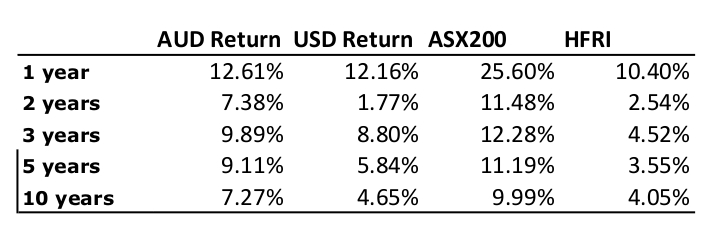
In recent years, we've followed the target portfolio quite closely. Here are annualized returns over various standard periods:

US Dollar returns are not very good over longer periods, but they still beat the HFRI, especially over the 3-5 year horizon.

Investment Allocation
The main change in allocation over the year was that we converted cash into bonds and gold and then began to run down the bond allocation mostly in favor of hedge funds:


Also, at the beginning of the year, I was still a part owner of my mother's apartment, which was then sold.

Accounts
Here are our annual accounts in Australian Dollars:


There are lots of quirks in the way I compute the accounts, which have gradually evolved over time. There is an explanation at the end of this post.

We earned $152k after tax in salary, business related refunds, medical payment refunds, tax refunds etc. We earned (pre-tax including unrealized capital gains) $251k on non-retirement account investments. The latter number was up strongly from last year. The former number continued its decline. The investment numbers benefited from the fall in the Australian Dollar ($40k in "forex" gain). Total current income was $403k. Not including mortgage interest we spent $133k. Total actual spending including mortgage interest was $147k, which was up 12.3% on last year.

$9k of the current pre-tax investment income was tax credits – we don't actually get that money so we need to deduct it to get to the change in net worth. We transferred $135k into retirement accounts from existing savings in "non-concessional (after tax) contributions. Near the end of the year we paid off the mortgage. Including mortgage payments during the year, that meant a total $520k transferred to our housing account.


The change in current net worth, was therefore -$394k. Looking at just saving from non-investment income, we dissaved $636k. Both these are crazy numbers...

The retirement account is a bit simpler. We made $46k in pre-tax contributions (after the 15% contribution tax) and made an estimated $204k in pre-tax returns. $23k in "tax credits" is an adjustment needed to get from the number I calculate as a pre-tax return to the after tax number. Taxes on returns are just estimated because all we get to see are the after tax returns. I do this exercise to make retirement and non-retirement returns comparable. Net worth of retirement accounts increased by $362k.

Finally, the housing account. I estimate that our house gained $24k in value. We spent $15k on mortgage interest. We would have paid $17k in mortgage interest if we didn't have an offset account. After counting the transfer of $520k into the housing account housing equity increased $527k of which $504k was due to paying off principal on our mortgage.

Total net worth increased by $495k, $48k of which was saving from non-investment sources. These numbers are steeply down from last year. The net worth increase last year mostly came from the inheritance.

Though our saving is down sharply on last year, we still saved in total 24% of our after tax non-investment income. Of course, this is less than last year's 33% and 2017's 54%! Including investment income our savings rate was 77%. This is based on our income calculated here at a ridiculously high $643k.

How Does This Compare to My Projection for This Year?
At the beginning of the year, I projected a gain in net worth of only $60k based on an 0% return on investments and a 6% increase in spending. As you can see, spending rose 12% and return on investments was also about 12%. As a result net worth increased by $495k. So, this was a big forecasting fail, as was last year's projection.

So, it's probably a mistake to try to make a projection for 2020 :) The baseline projection in my spreadsheet is for a 12% rate of return, a 6% increase in spending, and flat other income, leading to a $425k increase in net worth. I expect that forecast will fail big time again.

Notes to the Accounts
Current account is all non-retirement accounts and housing account income and spending. Then the other two are fairly self-explanatory. But housing spending only includes mortgage interest. Property taxes etc. are included in the current account. There is not a lot of logic to this except the "transfer to housing" is measured using the transfer from our checking account to our mortgage account. Current other income is reported after tax, while investment income is reported pre-tax. Net tax on investment income then gets subtracted from current income as our annual tax refund or extra payment gets included there. Retirement investment income gets reported pre-tax too while retirement contributions are after tax. For retirement accounts, "tax credits" is the imputed tax on investment earnings which is used to compute pre-tax earnings from the actual received amounts. For non-retirement accounts, "tax credits" are actual franking credits received on Australian dividends and the tax withheld on foreign investment income. Both of these are included in the pre-tax earning but are not actually received month to month as cash.... Finally, "core expenditure" for housing is the actual mortgage interest we paid. "Expenditure" adds back how much interest we saved by keeping money in our offset account. We include that saved interest in the current account as the earnings of that pile of cash. That virtual earning needs to be spent somewhere to balance the accounts... It is also included in the "transfer to housing". Our actual mortgage payments were less than the number reported by the $2k in saved interest. For current accounts "core expenditure" takes out business expenses that will be refunded by our employers and some one-off expenditures. This year, there are none of those one-off expenditures. "Saving" is the difference between "other income" net of transfers to other columns and spending in that column, while "change in net worth" also includes the investment income.