Monday, March 24, 2025

James Hardie and Regal Partners Trades


James Hardie (JHX.AX) announced that they are acquiring US company Azek and the merged company will have a primary listing on the NYSE, though still listed in Australia. James Hardie is actually incorporated in Ireland and so the Australian listing is a "CHESS Depositary Interest". Azek shareholders will have 26% of the total company. In reaction, Australian investors have heavily sold the company today on the ASX and it is down more than 12%. I bought shares on the following basis:

1. US analysts were upbeat on the merger on the investor call according to the AFR and US trade will be happening tonight after whatever happens today in Australia.

2. Having a primary US listing means the stock can be included in US indices with subsequent buying by passive index investors.

I'm down on the trade right now, but not too badly... 

Regal Partners (RPL.AX) got trashed again today. I think this is related to the story about Merricks' (a subsidiary) loan to a development in Sydney that is in trouble. Given, this loan is in a private credit fund and not on the balance sheet, I think this reaction (down 15%) is exaggerated. I bought more shares. 

P.S.

There is another negative story on Regal. Again, this doesn't justify such a large fall in the management company. It's a 1-2% fall in assets under management. However, it turns out that Opthea was 5.6% of assets at Regal Investment Fund (RF1.AX), which I am invested in. That is big for what is otherwise a super-diversified fund.

What it Takes to be in the Top 1% in Australia

Interesting article in the AFR on what it takes to be in the top 1% in Australia currently by both income and wealth. You can go to the free article to see lots of charts, so I won't post them here.

To be in the top 1% by income, you need a household income of AUD 532k. The top 5% is above AUD 306k. The top 10% starts at AUD 235k. I predict that our taxable income will be AUD 263k for this tax year. So we fall within the top 10%.

The wealth data are also broken down by age group. For the 41-64 age bracket the top 1% starts at AUD 7.7 million, while the top 5% starts at AUD 3.8 million. At AUD 7.4 million we are just outside the top 1%. Our average adult age is 55. The top 1% for 65+ starts from AUD 10.9 million!

There are also breakdowns by type of asset. The top 5% by home equity for our age band starts at AUD 1.42 million. So we are well below that. The top 25% is AUD 650k and above. We are within the top 25%.

A top 1% household superannuation balance is one of more than AUD 2 million. We are definitely in the top 1% by this criterion. Moominpapa alone has almost 1.9 million and Moominmama more than 900k. The top 1% of individuals starts at 1.4 million.

Sunday, March 23, 2025

Investments Review 6b: More Developing Stock Investments

Because of the delay in completing this review, the last of these is now an unprofitable investment!

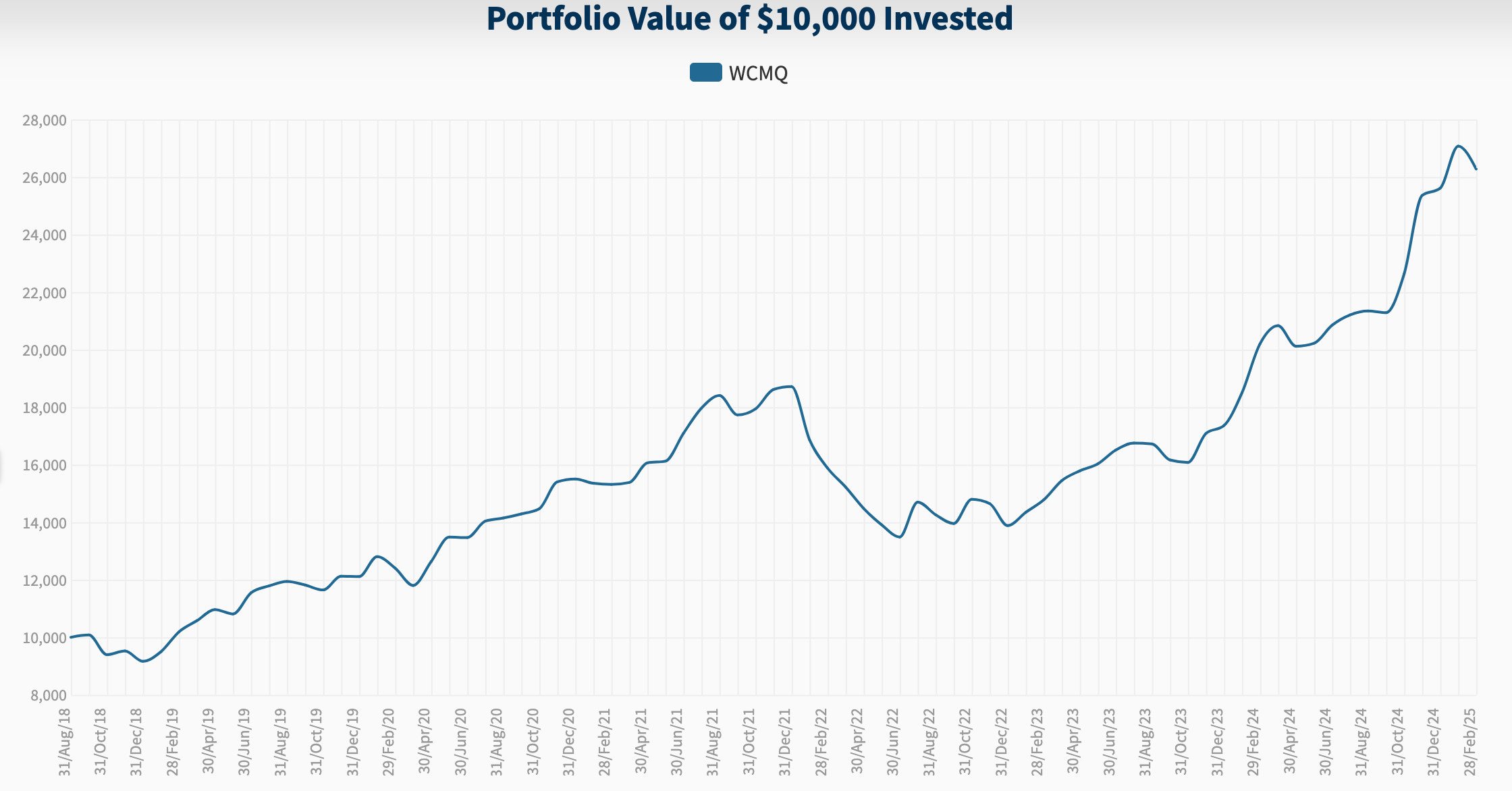
WCM Global (WCMQ.AX): 1.7% of net worth, 1RR 15%. This is an actively managed ETF that targets global "quality" stocks. It is managed by US manager WCM but is listed on the ASX.


There is a history of using this stock to fund other new investments (Bitcoin I think) and then more recently re-investing in it as it has a good track record:


The ASX gained 66% in this period and the MSCI 90%. Seems good to me.

WAM Strategic Value (WAR.AX): 1.6% of net worth, IRR 1%. This fund specializes in mainly investing in other listed funds that trade below NAV. We invested at the IPO (a mistake):


While overall it has done nothing much, it has done well in the last 1-2 years. I think this should be monitored. Maybe can be a source for investing in other things...

Regal Partners (RPL.AX): 1.4% of net worth, IRR -8%. This is a leading Australian alternative asset manager, which I normally include in the Australian small cap asset category. I thought this company was doing well, but since the release of the most recent earnings report, the market doesn't agree:


I think in the long-term they should do well or be acquired by a larger fund manager, so am inclined to hold. Of six analysts who follow this stock, five rate it a strong buy. Morningstar Quantitative value it at $3.16, about 10% above the current stock price.

Investments Review 6a: Developing Stock Investments

I decided to rename this category "developing" as opposed to the mature investments we considered earlier. This section covers five Australian funds and stocks. The first two are in this post. Graphs are all in Australian Dollars.

First Sentier Imputation Fund: We now have 1.6% of net worth in this fund. This is the last remaining investment in an account, which was once my core investment. The fund aims to combine long-term capital growth with tax-effective income by targeting Australian growth companies with a high level of franked dividends. It aims to outperform the S&P/ASX 300 Accumulation Index over rolling three year periods before fees and taxes.

The fund has consistently outperformed its benchmark:

Our IRR is 16%. The only downside of this fund is that the unlisted unit trust structure is not very tax efficient, as all gains are paid out in distributions. An alternative is Wilson Asset Management's Leaders Fund (WLE.AX), which is more tax efficient. We have held that for a while in the past but ended up selling to raise cash for other investments. It has done better over three and five years than FS Imputation but much worse in the last year.

This was one of my earliest investments but then I didn't hold any for 20 years until 2021 when I began to consolidate other funds in the account into it. Distributions gradually pay back our investment.

Cadence Opportunities Fund (CDO.AX): 2.5% of net worth. IRR is only 3.5%. It is a long-biased listed Australian equity hedge fund. I recently consolidated my investment in sister fund CDM.AX into this one. 


CDO has more flexibility to quickly trade in and out of positions. Initially, the fund did extremely well. Then it became practically a twin of CDM. However, recently it has again begin to diverge in a positive way from CDM. It's not really doing well though. It's still way below the 2022 peak, unlike CFS Imputation above. Unless it starts to do a lot better soon, I don't think there is a good reason to hold it.

Friday, March 21, 2025

Metrics


Count Financial told clients to sell private credit funds managed by Metrics Credit Partners. This crashed the share price of MOT.AX, one of their funds that I have owned before. So, I bought some on Wednesday for a trade as I think the sell-off is exaggerated even if the true NAV of the fund is less than the stated $2.14. The share price rebounded a bit. Wondering whether to close the trade?

P.S. 22Mar25

I did sell the shares, booking about AUD 1,400 in profit.

Another Perspective on the UK Pension

Here is another way of looking at the UK pension, which I have applied to contribute to. Our net worth not counting our house is about AUD 6 million. Using the 4% rule, we could withdraw AUD 240k per year. Currently, our spending is below that, which is why I have been thinking about retirement. The pension would add almost AUD 20k per year to that.* And the contributions would only be around 1/2% of the 6 million.

* This depends on how much tax we end up paying in retirement. Based on last year's tax return, if I stopped working I would earn AUD 56k p.a. So, my marginal tax rate would be 32%, which would apply to this additional income. That seems like a really high rate at such a nominally low income.

Thursday, March 20, 2025

UK Pension


This was totally not on my radar. When procrastinating on Wednesday, I saw an article in the Fin Review about how Australians who had worked 3 years+ in the UK could claim a UK pension by making extra contributions from overseas. The article explained that UK citizens in Australia could also do this. You need a minimum of 10 years of contributions to get the pension. If you have 35 years of contributions, you get the full pension of £11,500 per year currently. Unlike Australia, there is no means testing.

More than 35 years ago, I got letters from National Insurance in the UK, (I was living in Israel most of the time then) asking whether I wanted to make voluntary contributions to the UK pension. At the time, I was an undergrad student and the payment was a good chunk of money for me. I discussed it with my father. He argued that I could make more payments later and anyway who knew if there would be a state pension when I was ready to retire. So, I didn't make any contributions. So, I knew about voluntary contributions, but didn't realize I could be making them now. Most importantly, I didn't realize what a fantastic investment this is!

The main point in the AFR article is that up to 19 April this year it is possible to make contributions for the 12 years between 2006 and 2018. After this date, it will only be possible to contribute for the previous six years.

So, Wednesday evening I set up a digital ID on Government Gateway - the UK's equivalent of Australia's MyGov. It turned out that I could use my Australian passport to identify myself. My UK passport expired in 2024... This allowed me to check my record of contributions. Then, this afternoon, I submitted my application to make voluntary contributions. They will process the application and then send me payment details. Mainly, I had to enter information about my last UK employer and the employers I have had since I left the UK. Luckily, there are only three of these and I have a good idea of the dates I started and finished at each one.

Who knows whether they will process the application by the deadline for adding the extra 12 years of contributions, but at least I tried.

It turns out that I have 7 full years of contributions. They even counted years when I was over 16 and in high school! So, if I could add the 12 extra years, the most recent 6 years, and the 7 years till I am 67, I will have a total of 32 years, which will give me 91% of the full pension! Even without the extra 12 years I would have 57% of the full pension.

OK, so why is this such a fantastic investment? Each additional year of contributions buys £11,500/35 per year in extra pension or £329. The most recent years cost only around £900 in contributions! So, you are buying an annuity that starts at age 67 paying an annual dividend of 37%! All your contributions will be paid back by the time of your 70th birthday, and the payments after that are pure profit! If I live to the same age as both my parents did then the internal rate of return would be a real (i.e. assuming zero inflation) 17%. That's not far behind our track record with 3i (III.L).

This is a no-brainer investment.  

P.S. 21 March 2025

My brother says that if they get back to you after the deadline they will still let you pay as long as you lodged before the deadline. Good news if true.