Monday, October 07, 2019

2018-19 Taxes

Here are my taxes for another year:

On the income side, Australian dividends, capital gains, and foreign source income are all up strongly. I finally ran out of past capital gains tax losses and so recorded a net capital gain for the first time in a decade. Foreign source income is mostly from futures trading and bond interest. My salary still dominates my income sources. As far as replacing salary with other income goes, you need to consider the joint picture with Moominmama's tax return below and the earnings of our superannuation accounts...

Increased deductions are mostly due to increased margin loan interest.

Franking credits (from Australian dividends), foreign tax paid, and the Early Stage Venture Capital (ESVCLP) offset are all deducted from gross tax to arrive at the tax assessment. Unlike in the past, I expect to pay a lot of extra tax.

Gross cash income deducts franking credits and adds the long-term capital gains discount to gross income. The former aren't paid out as cash and the latter are but aren't included in taxable income.
Net after tax cash income then deducts tax and deductions from gross cash income.

Moominmama's (formerly Snork Maiden) taxes follow:

Here there is more dramatic change. Salary was up further in the bounce back from maternity leave and in preparation for the second maternity leave now in progress. Foreign source income was up dramatically due to futures trading. We do more of our trading in this lower taxed account.

Work related travel expenses were down to almost nothing, as the tax year started during our last big trip to conferences etc. I haven't yet managed to do the mortgage inversion that should increase deductions and so deductions are down.

As a result, income and taxes were up dramatically and we will owe a lot of tax. I expect we will have to start making quarterly tax payments from now on.

Trading Progress

I've now tested Bitcoin, ASX200, palladium, and crude oil futures trading using Barchart data. So far, only ASX200 futures were not profitable. I'm now trading one contract long or short of Bitcoin futures, trading palladium with position sizing using CFDs, and have put in an order to short crude oil futures.

With palladium I am aiming to risk about 10% of the CFD account on each trade. My current position is long 10 ounces of palladium and I have an order to short 20 ounces of palladium. The typical risk for trading a 100 ounce palladium futures contract is too big at this stage. The contract face value is around USD 160k. So, even if the stop is 5% from the current price you are risking USD 8000.

On the other hand, a crude oil contract has a face value of around USD 50k (1000 barrels of oil). I am targeting 5% of the face value as the risk we can take on. To compute the number of contracts we can trade we calculate: 0.05*price/abs(price-stop) and round it up or down to the nearest integer. If that is zero then we don't put an order in. This is why I only have a short order at the moment and no order to go long.

Both oil and palladium have longer optimal periods for measuring breakouts against than Bitcoin does. My palladium strategy looks for breakouts from the last seven days of prices in either direction. My oil strategy uses breakouts from the last eleven days. However, it will exit a long (short) position if the price falls below (rises above) the previous day's low (high).

Palladium has about the same risk/return trade off as Bitcoin, but oil isn't as good a risk/return ratio. Here are the average maximum potential loss and the average trade profit for trading with a single contract:

Bitcoin: Risk =  USD 3,722, profit = USD 1,036, ratio = 0.28
Palladium: Risk = USD 4,910, profit = USD 1.462, ratio = 0.30
Crude oil: Risk = USD 2,030, profit =  USD 225, ratio = 0.11

Compared to face value of the contract, the average Bitcoin profit is a 2.7% return, while for palladium and oil it is 0.9% and 0.4%, respectively. Relative to required margin, though, Bitcoin is not so good compared to the others.

The reason for trading all three of them at this stage is for diversification. I want to have more consistent returns rather than boom and bust. That's why I am still allocating the largest amount of risk to Bitcoin. I also still have a treasuries futures trade on and am long more than 100 ounces of gold via the IAU ETF.

At this point, I think I got beyond the experimental stage of trading and am now in a more developmental period. My backtesting programs work pretty well, I have good quality data, am more used to trading in a disciplined way, and am now testing which markets and position sizes make most sense.

Wednesday, October 02, 2019

September 2019 Report

In September the Australian Dollar fell from USD 0.6729 to USD 0.6752. The MSCI World Index rose 2.15% and the S&P 500 1.87%. The ASX 200 rose 2.08%. All these are total returns including dividends. We gained 0.52% in Australian Dollar terms and 0.87% in US Dollar terms. The target portfolio lost 0.28% in Australian Dollar terms and the HFRI hedge fund index lost 0.27% in US Dollar terms. So, though we under-performed all three stock indices we out-performed our target portfolio and the HFRI. Updating the monthly returns chart:


Here is a report on the performance of investments by asset class (futures includes managed futures and futures trading):
Private equity and hedge funds did very well while gold and futures did poorly. The largest positive contribution to the rate of return came from hedge funds greatest detractor was gold, which was the exact reverse of the previous month. The returns reported here are in currency neutral terms.

Things that worked well this month:
  • Hedge funds shined as Platinum Capital, Regal, and Cadence gained significantly but Tribeca lost more money.
  • Pengana Private Equity gained.
What really didn't work:
  • Gold and Winton Global Alpha lost significantly, partly reversing recent gains.
  • Tribeca lost as noted above.
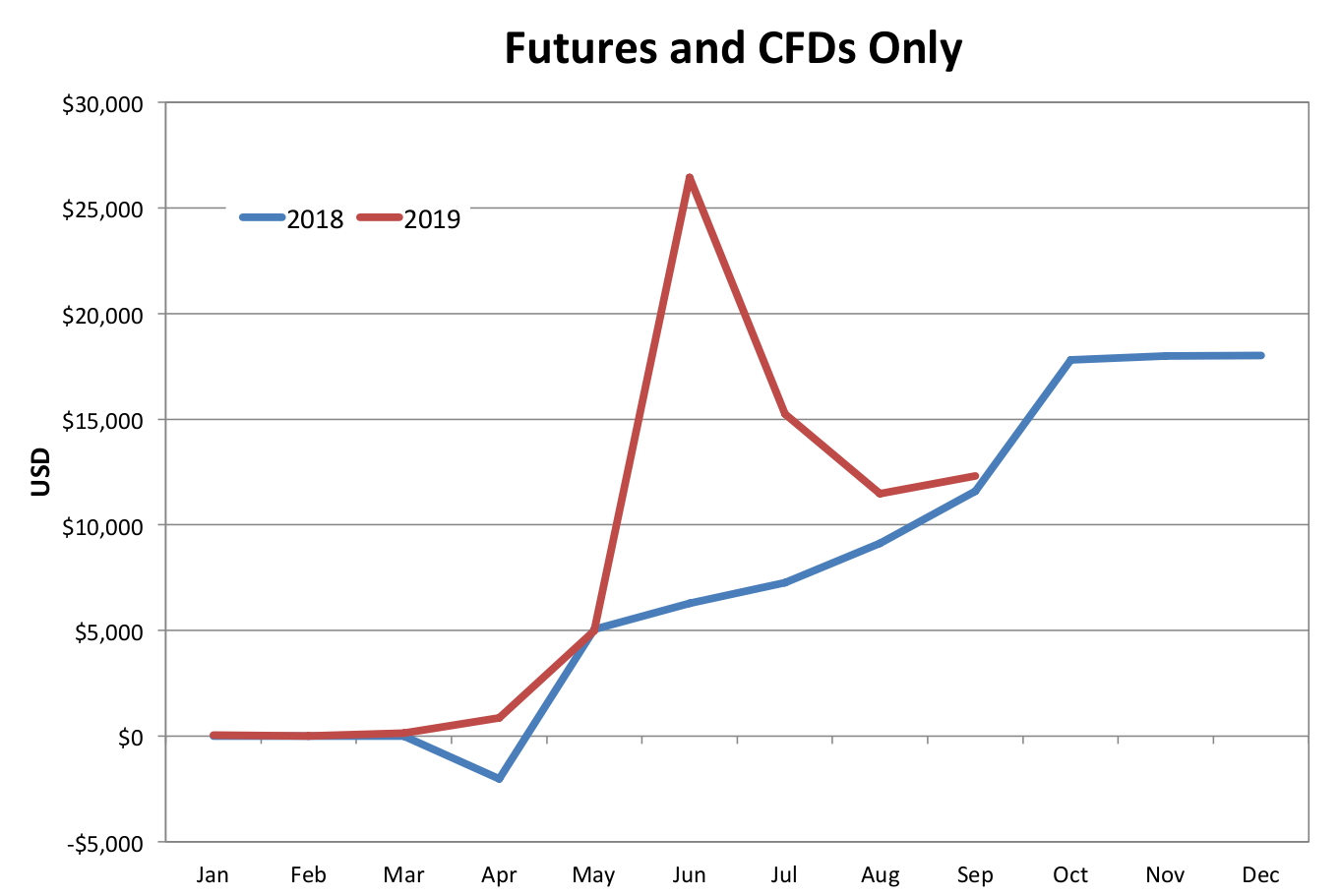
Trading: We gained modestly in Bitcoin and US treasuries futures and lost moderately in Palladium and big time in gold. Using a narrower definition including only futures and CFDs we gained 0.48% on capital used in trading. Including ETFs we lost 1.53%. Using both definitions we are a bit ahead of where we were at this point last year. This graph shows cumulative trading gains year to date:


The picture is better using the broader definition.

We moved a further towards our new long-run asset allocation.* Cash increased most and private equity and bonds decreased most as we received the proceeds from the IPE.AX delisting:


On a regular basis, we also invest AUD 2k monthly in a set of managed funds, and there are also retirement contributions. Then there are distributions from funds, dividends, and interest. Other moves this month:
  • We sold $50k of Tenet Health Care bonds when they were called and $50k of Discovery Bonds matured. We bought $50k of HSBC bonds So, our direct bond holdings declined by $50k.
  • We traded with moderate success, as discussed above.
  • I bought a small number of Platinum Capital shares as their price was a lot below net asset value.
  • We started buying Australian Dollars again, buying AUD 20k this month.
  • We received the proceeds from the delisting of Oceania Capital.
  • As a result of all this our cash holdings increased by around AUD 120k.
* Total leverage includes borrowing inside leveraged (geared) mutual (managed) funds. The allocation is according to total assets including the true exposure in leveraged funds. We currently don't have any leveraged funds.

Saturday, September 28, 2019

ASX200 Futures

I put together a dataset for the ASX 200 futures for the past 5 years - Barchart have this data. Every possible "Turtle" strategy I tested lost money. So, we're definitely not going to trade this! I tested breakouts from 1 to 40 day periods and they all have similar poor performance. Position sizing to always trade the same percentage risk made things much worse.

Here is a 2,2 strategy without position sizing assuming no slippage – The best case scenario:


The blue line is the continuous futures contract price I constructed and black is the equity line of the strategy. This actually makes a slight gain over the 1200 trading days. But including reasonable slippage, it will turn into a loss. A 2,2 strategy means that you buy or sell breakouts from the previous two days highs or lows and exit those positions on breakouts from the same number of trading days in the opposite direction.

I have now put on a small (10 ounce) Palladium trade using CFDs. I'll probably test trading oil next.

Monday, September 23, 2019

Data Quality Matters

I did an analysis of the optimal trading strategy for Palladium futures using Barchart data. Previously, using free data, I had found that we should make trading decisions based on very short periods of past prices. For example we might go long (short) if prices broke out above (below) the previous day's high (low), or maybe the high or low of the previous two days. Now I find that the optimal strategies use periods of 7 to 18 days for breakouts. This shows that using good quality data really matters in trading, and not just a little bit. Using one day breakouts would actually lose money over the last five years of data that I tested. I lost money on all the Palladium trades I previously made... though four trades is not a large sample.


At the moment Palladium is in a winning long trade, but I am reluctant to go long at this point. So, I put in a short trade which will activate if the market reverses.

I also found out today that Barchart has past ASX 200 futures prices. I don't know if these are as high quality as their US futures data.  I will download them next.

Sunday, September 15, 2019

Variable Position Size, Again

I signed up for the Barchart Premier subscription. Among other things, this gives access to daily open, high, low, close etc. data for all US based futures contracts back to 2000. The data seems to be much more accurate than the various free sources. To start with, I downloaded all Bitcoin futures contracts data. I constructed a continuous series of prices going back to the beginning of trading in Bitcoin futures. I use proportional splicing that preserves percentage changes rather than absolute dollar changes. I also saved the actual futures prices for computing trading costs.

When we include the very volatile period right after the all time high in Bitcoin, the optimal trading strategy changes:


This graph shows the drawdown for a simple strategy that always buys the same number of contracts (in red) with a strategy that always has the same initial risk in percentage terms (in green). The latter targets a constant maximum 5% potential loss of the face value of the Bitcoin contracts before stopping out. The simple strategy soon finds itself 40% down at the end of January 2018. On the other hand, it manages to claw back that loss by late March... The constant risk strategy only loses a maximum of 15% over this period. On the other hand it performed worse during the string of 11 losing trades in a row in late 2018. But the Sharpe ratio for the constant risk strategy (2.45) is quite a lot higher than for the constant position size strategy (2.21). So, I am going to start varying position size, targeting a maximum loss of USD 5,000.

I will also start to revisit other markets to see where there is potential.

Previously, I found that there was a positive relationship between the initial risk of a trade and its return. When volatility is low moves seem to be more noise than signal. Looking at the relationship between initial risk and return, there is now a negative correlation between them, though it isn't statistically significant:


On the other hand,  the "lowest risk" trades here mostly had negative outcomes.
 

Wednesday, September 04, 2019

Individual Investment Returns, August 2019

Following up on the monthly report for August, here are the returns of each individual investment or trade. As usual, I have aggregated all the individual bonds (23 of them) we have into one number. As discussed in the monthly report, gold and the Winton Global Alpha Fund did exceptionally well, some hedge funds (Tribeca and Platinum Capital, in particular) did badly, and diversified funds like CFS Conservative, CREF Social Choice, and PSS(AP) weathered the month well.  Real estate investments did OK. The CFS Developing Companies fund also bucked the trend for the month.