Monday, July 18, 2022

A Tale of Two Bloggers

Enough Wealth has a new post comparing our two NetWorthShare net worth curves titled a Tale of Two Bloggers. He took out the step changes due to inheritance in both our histories. But the two curves are in different currencies - mine in USD and his in AUD despite us both living in Australia. I wanted my track record to be comparable to the majority of other members who are US based. The volatility of my net worth is much lower in AUD than in USD. This is by design. The Australian Dollar tends to fall during "risk-off" periods reducing losses in AUD terms and increasing them in USD terms.

So, I thought I'd post a comparison of my net worth curve in both AUD and USD terms:


These go back way before the record on NetWorthShare. Back to September 1990, the month I started my PhD in the US... In addition to bigger moves during bear markets, the US series has a number of flat periods compared to the AUD series - around 2015, 2018-19 and in 2021. Overall, the AUD curve ascends more smoothly. We can also reminisce about that time after the GFC when the Australian Dollar was worth more than the US Dollar!


Saturday, July 16, 2022

Division 293 Humblebrag

It looks like I will have to pay Division 293 superannuation contributions tax for the first time. This is an extra 15% tax on superannuation contributions that you have to pay if your income including concessional super contributions is above AUD 250k. My preliminary estimate of my taxable income is already above AUD 250k. So, for sure the total including around 30k of super contributions will be even if the final income number is a little lower. This is probably going to mean an extra AUD 4,500 of tax. 

I'm also currently estimating I'll owe more than AUD 13k in extra tax after paying AUD 6k in tax installments. Last year I got a tax refund because of the Virgin Australia debacle. Bond losses can be deducted immediately from your income unlike losses on shares. The tax installments were because the previous year's tax return...

I'm reluctant to stuff more money into super as non-concessional contributions to reduce tax in case we'll need it. For example, to buy a bigger or better located house. If I continue to work, we can't withdraw the money from my account till I'm 65 in 8 years time. And much longer in Moominmama's case. That liquidity costs in taxes. 

In the last couple of years we made large non-concessional contributions. I also have illiquid investments in venture capital and art. Our liquid investments are 46% of gross assets not including our house. I doubt I can get a bigger mortgage given my age and Moominmama's low wage income.

Tuesday, July 12, 2022

Some Good Financial News


Masterworks sold Lured by Cecily Brown for USD 1 million. The initial offer price was USD 605k. We are supposed to get the money within a month. I think this is the third painting they have sold, two of which were ones I invested in. 

Domacom reported to the ASX that their private placement was over-subscribed! They hope to be reintstated in the ASX soon.

Sunday, July 10, 2022

Portfolio Planning

I won't post June accounts for quite a while. There doesn't seem much point until we have all valuations for private assets for the end of the financial year and that won't happen till some time in August probably.

I did a bit of a portfolio planning exercise again with some moves planned. I tweaked the portfolio allocation a little as a result to meet the various constraints. Target allocation to Australian large cap is down from 8% to 7%, hedge fund allocation down from 25% to 24% and bonds and futures both up from 5% to 6%. Other allocations remain unchanged (real assets 15%, private equity 15%, international shares 11%, gold 10%, and cash 1%). Back in 2017, our Australian large cap allocation was 35-36%!

In theory, the new allocation does increase the historical portfolio Sharpe ratio. 

So here is the current allocation where I break down by asset class and type of holding:

You are going to need to click on this to see any detail. The names at the bottom are most of the relevant investments in that category. Employer super includes my US retirement account as well. I originally developed this spreadsheet when we were planning the SMSF. Then the future allocation tries to move more towards the long run allocation while taking into account the amount of money in each pot and what the employer super is invested in etc.

It also reflects that we are probably going to get the cash back from our investment in PSTH, which is then reinvested in the SMSF. I want to move my holding of Aspect Diversified Futures into the SMSF  I will sell and buy again rather than actually move it as I plan to buy a class with lower fees. With the proceeds from selling Aspect we invest in Australian small cap and international shares. We then use the proceeds from PSTH to buy Aspect in the super fund. Plus a $20k concessional contribution for Moominmama I just made. Otherwise, the allocation says we need to increase holdings of real assets outside of super a lot. I don't know what those investments would be...


Saturday, July 02, 2022

Spending 2021-22

For the last five years I've been putting together reports on our spending over the Australian financial year, which runs from 1 July to 30 June. This makes it easy to do a break down of gross income including taxes that's comparable to many you'll see online, though all our numbers are in Australian Dollars. At the top level we can break down total income (as reported in our tax returns plus superannuation contributions):
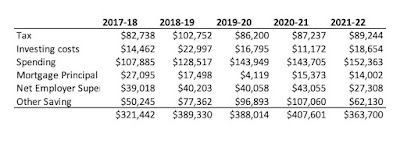
The gross income for this year (bottom line) is just an estimate. It looks like falling quite significantly. Tax includes local property tax as well as income tax and tax on superannuation contributions. Investing costs include margin interest. Mortgage interest is included in spending, while mortgage principal payments are considered as saving. Spending also includes the insurance premia paid through our superannuation. Current saving is then what is left over. This is much bigger than saving out of salaries because gross income includes investment returns reported in our tax returns. The latter number depends on capital gains reported for tax purposes, so is fairly arbitrary. Spending also recommenced its increase this year. Graphically, it looks like this:

We break down spending into quite detailed categories. Some of these are then aggregated up into broader categories:


Our biggest spending category, if we don't count tax, is now childcare and education, which has again risen steeply. As mentioned above, the income and tax numbers are all estimates. Commentary on each category follows:

Employer superannuation contributions: These include employer contributions and salary sacrificed contributions but not concessional contributions we paid to the SMSF this year.

Superannuation contributions tax: The 15% tax on concessional superannuation contributions. This year it includes tax on our concessional contributions to the SMSF.

Franking credits: Income reported on our tax returns includes franking credits (tax paid by companies we invest in). We need to deduct this money which we don't receive as cash but is included in gross income. Foreign tax paid is the same story.

Life and disability insurance: I have been trying to bring this under control and the amount paid has fallen as a result.

Health: Includes health insurance and direct spending. Spending peaked with the birth of our second child and continues to decline.

Housing: Includes mortgage interest, maintenance, and body corporate fees (condo association). We haven't spent much on maintenance this year, so spending is down.

Transport: About 2/3 is spending on our car and 1/3 my spending on Uber, e-scooters, buses etc.

Utilities: This includes spending on online subscriptions etc as well as more conventional utilities. I need to cut back on spending on video games as this category continued to climb strongly.

Supermarkets: Includes convenience stores, liquor stores etc as well as supermarkets. Seems crazy that it has almost doubled in five years and become our second biggest spending category.

Restaurants: This was low in 2017-18 because we spent a lot of cash at restaurants. It was low last year because of the pandemic and this year because of a seeming permanent behavior change.

Cash spending: This has collapsed to zero. I mainly use cash to pay Moomin pocket money and he pays me back if we buy stuff online for him. That's how it ended up negative for the year. Moominmama also gets some cash out at supermarkets that is included in that category.

Department stores: All other stores selling goods that aren't supermarkets. No real trend here.

Mail order: This seems to have leveled out in the last three years/

Childcare and education: We are paying for private school for one child, full time daycare for the other, plus music classes, swimming classes...

Travel: This includes flights, hotels etc. It was very high in 2017-18 when we went to Europe and Japan. Last year it was down to zero due to the pandemic and having a small child. This year we went to the nearby coast for a week and this is mostly how much the accommodation, booked at the last minute, cost.

Charity: Not sure why it's down this year.

Other: This is mostly other services. It includes everything from haircuts to professional photography.

This year's increased spending was mainly driven by increased childcare and education costs. I expect these to be about the same next year and then fall for a while in subsequent years - private primary school is cheaper than daycare with the low level of subsidy we get - before beginning to rise again.


Monday, June 06, 2022

New Investment: Regal Partners

Regal Partners just merged with VGI to create a new larger alternative fund manager that will be known by the former name. The company still trades under the VGI.AX ticker but is expected to switch to RPL.AX. It seems undervalued to me at a PE of 6 and so I bought some shares. Especially, as that is based on VGI's inferior track record to date.

Thursday, June 02, 2022

May 2022 Report

World markets stabilized with the MSCI World Index (USD gross) rising by 0.19% and the S&P 500 by 0.18%. On the other hand, the ASX 200 fell 2.43%. All these are total returns including dividends. The Australian Dollar rose from USD 0.7114 to USD 0.7177 increasing Australian Dollar returns and reducing USD returns. Our luck ended this month, and we lost 3.10% in Australian Dollar terms or 2.24% in US Dollar terms. The target portfolio lost 1.05% in Australian Dollar terms and the HFRI hedge fund index is expected to gain 0.21% in US Dollar terms. So, we under-performed all benchmarks.

Here is a report on the performance of investments by asset class (currency neutral returns in terms of gross assets): 

Hedge funds were the worst drag on performance followed by gold. Only futures and real assets had positive returns.

Things that worked well this month:

  • TIAA Real Estate (AUD 4k), Australian Dollar Futures (4k), and URF  (also 4k) were the best performers.

What really didn't work:

  • Tribeca Global Resources (- AUD 25k), gold (-19k), and Pershing Square Holdings (-18k) were the three worst performers...

 The investment performance statistics for the last five years are: 

The first two rows are our unadjusted performance numbers in US and Australian dollar terms. The following four lines compare performance against each of the three indices over the last 60 months. We show the desired asymmetric capture and positive alpha against the ASX200 and the MSCI but not against the hedge fund index. We are performing 1% per annum worse than the average hedge fund levered 1.67 times.

We moved a little bit nearer to our target allocation. Our actual allocation currently looks like this:


70% of our portfolio is in what are often considered to be alternative assets: real estate, art, hedge funds, private equity, gold, and futures. A lot of these are listed investments or investments with daily, monthly, or quarterly liquidity, so our portfolio is not as illiquid as you might think. On the other hand, around 47% of net worth (not including our house) are now in retirement accounts. Liquid investments are 57% of net worth and illiquid non-retirement investments are 13% of net worth. Because of leverage, the total is 117%. 

We receive employer contributions to superannuation every two weeks. In addition we made the following investment moves this month. It was a busy month.

  • I bought 1,000 shares of 3i (III.L) after its share price fell in sympathy with US retailers like Target and Costco. I figured that the problems those faced probably weren't that similar to those faced by Action – 3i's European discount retailer. 3i also posted very good results recently.
  • I sold all our shares in URF at 27 cents a share.
  • I made additional investments in APSEC and the Australian Unity Diversified Property Fund.
  • We made a small investment in a start-up via Unpopular Ventures syndicate.
  • There were a lot of small trades involved with forex, tax loss harvesting, moving positions between accounts etc...