Moomin Valley

Personal Finance, Trading, and Investing

New York
Sydney
Beijing
Locations of visitors to this page

Tuesday, July 01, 2008

June Finally Over

Trading realised gains were $223. Everything else looks horrible. The only other positive spots were: NNDS, TFSMX, LUV, and LGDI. A few other investments were breakeven ish.

Labels: , , ,

Monday, June 30, 2008

"Gurus" Lose Even More Money

Interesting league table of returns of "gurus" over the last 6 and 12 months. I estimate I'm down 10% over six months and 5% over 12 months. That's similar to Soros and would be one of the best returns in the table. Real numbers coming in a few days.

Labels:

Saturday, June 28, 2008

Worst Since the Great Depression


There is a lot of talk that this is the worst June for the Dow since the Great Depression and the worst month since the 2000-02 bear market. I haven't run the numbers in a while, or posted that much, as they are so bad, but clearly this is my worst month since the 2000-02 bear market. I didn't bet on such a major retracement in the indices - about a 50% retracement of the March-May rally in the NDX, a new bear market low for the Dow, and a pretty much 100% retracement for the SPX. I've been trading on the wrong side of the market for the whole month, somehow, despite this, my trading result should be a little positive unless something real bad happens on Monday but that is offset by horrible investment returns. Friday night in the US my trading positions did go in my direction as the market reversed to the upside in reaction to a collapse in the oil price from a new all time high. The price of oil really drives the US stock market now, second by second. We are going to need to see a substantial fall in the oil price to get any rally going in stocks. I think that's possible. Recent highs in oil seem weaker as they are being made on lower volume etc.

On another positive note, after the close Friday, News Corp announced that it plans to privatise NDS at $60 per share. I currently have 100 shares. My brother is employed by NDS, which is how I heard about it in the first place. It's always been a bit hard to understand why the company was public given the overwhelming majority stake News Corp held. One excuse I heard was that it was to provide incentive options to staff who owned many of the remaining shares. Also, I've not yet seen any explanation as to why News Corp wants to take the company private now.

Labels: ,

Friday, June 20, 2008

Three Bad Trades: Two (?) Down, One to Go

Last week I was in three bad trades on each of which I was down significantly. One was long NASDAQ futures, another short QQQQ puts, and the third long SPI (Australian stock futures via CFDs). I managed to close out the long NASDAQ position for a small profit. Tonight, I will close the QQQQ puts position. We will see if for a small profit or a small loss. I could have closed last night for a small profit, but didn't pull the trigger. The long SPI position is still bad, though no worse than it was. I guess I am resigned to waiting for the index to eventually go up, which is a safer bet when you're long than when you are short. I am learning, I hope from the mistakes I made on all of these trades. Otherwise, there are only a few bright spots - Legend International and Southwest Airlines are a couple of them. I took some profits in both of them. Another good recent trade is selling June covered call options on Interactive Brokers. I got $100 for two of the $35 calls just a couple of days ago and the stock promptly sank. I can't see it coming back to $35 tonight.

By the way, I think we may have seen the top in crude oil for a while. Last night's decline in the wake of the Chinese petrol price increases was pretty spectacular and certainly fueled the rally in stocks, which saved my QQQQ trade. If the downtrend continues, it will be the catalyst for the next upwave in stocks. At least in the US. Australia is another question.

On top of struggling with trading this month, yesterday I had a computer mishap when trying to back up my files. I lost a bunch of financial files or now only have the version from September last year. Luckily, none of the most crucial core files was affected. But I did lose my last couple of tax spreadsheets, including the one I have been putting together for 2007-8 Australian taxes. I'll have to reconstruct it from scratch. All the sources are intact at least, just a question of bringing everything together.

Labels: , ,

Tuesday, June 17, 2008

Macquarie Capital Alliance Group to be Privatised

Another Macquarie private equity listed fund to be delisted. This bodes well for my various Australian listed funds that are trading at huge discounts to book value: EBI, AEP, IPE, CAM, and PMC. Though CAM and PMC are more traditional share funds. EBI continues to attract new hedge fund investors. The manager of the fund referenced in the EBI announcement, Andrew Weiss, was a professor of economics at my Alma Mater, Boston University. I remember once I went to look for him for some reason, but never did meet him. Some grad student was sitting in his office. EBI are going to introduce a buyback facility that will come into play whenever the fund trades 10% below book value. The problem with AEP is of course that it was an Allco sponsored fund, so no privatization likely there, though I expect another more serious takeover effort if it continues to trade so cheaply.

Labels:

Monday, June 16, 2008

Another similarity with 1990-91

Record levels of bearishness. As I write, oil just spiked to a new all time high. Seems to me this was a reaction to a bad Empire State Report (NY Fed report on NYS economy) which caused US bonds to rise and therefore the USD to fall. This started a rise in the oil price that then set off a cascade of stop losses at $137, $138, and $139. At least that's what the charts look like... Dow Jones commented on the price spike but didn't report any news except the Saudi decision to raise output which was already known and bearish for the oil price.

Labels: , ,

Sunday, June 15, 2008

Mid-Month Update


The numbers in the right column look really awful. The only goal where we're making progress at this point in the month is on realized gains with a net $487 gain so far this month. Investment performance is -7.81% so far against a 4.59% loss for the MSCI and 2.88% loss for the SPX. Numbers were worse before the start of Friday's trading by around $4000 and at the end of Friday were in fact better than this - but there is always a delay in getting the prices for Australian managed funds (mutual funds). The numbers are also better in Australian Dollar terms (-6.34%) as the Australian Dollar is down on the month. I think this is the worst point of the month and hopefully, month ending numbers will be better. The main reason for the poor performance is our much higher level of leverage since April - estimated beta is 1.06 (time series estimate) to 1.34 (naive estimate).

Labels:

Saturday, June 14, 2008

Immigration


Another goal completed, Friday, when we visited the Department of Immigration in Canberra to turn in Snork Maiden's immigration application and pay the $A2,060 fee. When processed they should award her temporary residence status in Australia. As a temporary resident you can work and receive government healthcare (Medicare). You can't receive other government benefits. After two years, our savings in health insurance should pay for the fee. Also after two years, they should grant her permanent residence in Australia and all rights apart from the ability to vote. Another two years on she should be able to obtain Australian citizenship with the obligation to vote and an Australian passport that allows visa free travel to most countries in the world. Still, today we were discussing maybe stopping off in another Asian country on our way back from China later this year. With an Australian work visa, getting a visa for Thailand, Singapore, or Hong Kong should be easy and the embassies are here in Canberra. I've been to both Thailand and Singapore as well as Malaysia. I'd like to visit Hong Kong some time, but no rush. Snork Maiden is most interested in visiting Thailand, I guess because that is the most exotic for someone from China.

The stockmarket finally has turned for the upside on Friday. This week, my trading was not at all good and by Thursday I was running three positions at close to $1,000 losses in each case. It was a rather anxious week. Friday night I got rid of a US futures position at a profit and my Australian futures (via a CFD) and US short options positions significantly improved. I'm not even calculating our current net worth or investment performance at this point in the month as I know they are so bad. I think Wednesday (Thursday in Aus) will be the low point for a while in the market. Wednesday was "Weird Wollie Wed" - the Wednesday of the week before US options expiry week. It seems the market often rises from there into options expiration and my model is now unequivocally pointing up.

Labels: , , ,

Wednesday, June 11, 2008

Australian Stock Market Update


The chart shows progress so far since all time highs in the Australian stock market at the end of October. A suggested Elliott Wave count consisting of a triple zig-zag W-X-Y-X-Z is shown. In US markets I believe the top was in July. The move out of the August low in Australia has five waves though and plausible counts from the 2003 low place it as the top of the market. Of course, other counts from the high to the March low are possible, but I think this is the most plausible. All E-Wave analysis can tell us, is that the decline, could be complete. The correction might simply be the first wave of a much larger correction if the more bearish scenarios play out. I've also sketched a five wave rise from the March low to the May high. Wave 4, in this sequence doesn't look much like a correction, but this count again is the most plausible. The move down from the May high also looks "impulsive". We've now hit the lower Bollinger Band (34 day moving average minus 2 standard deviations, which is a natural point to attempt a bounce, especially when the moving average is not declining. At the January and March lows the BB didn't arrest the decline immediately, as you can see the moving average and bands were declining steeply. So I expect a bounce of some duration here, and the model is forecasting a rise too in coming days. We are also just above the August low.

This point in the market does seem similar to the January Societé General and March Bear Stearns lows. This is the Lehman low, where Lehman did not blow up but was rescued with a private capital injection. I've also marked a possible inverted head and shoulders bottom. We need to rise above the 6000 level and break through the blue resistance line before this comes into play. If it does, expect a move to the old highs as a minimum target. That's the bullish scenario. Any move down from here would be very bearish. I'm betting on the bullish outcome.

Overnight, the US market seemed to stabilize, Japanese futures are up pre-open as I write. Let's see what happens.

Labels:

Wednesday, June 04, 2008

New Investment: Legend International


Legend International is a company run by Joseph Gutnick that is developing a major phosphate mine in northwest Queensland. The stock is an OTC-BB stock in the US, but following a successful private placement the company plans to list on the American stock exchange. The company also plans a secondary listing on the ASX. I bought some shares a few days ago. I compute that based on:

• The company's worst case scenario of a phosphate price less than half current prices
• Assuming that they still need to raise another $700 million to finance the development of the mine by issuing shares at the current share price.
• Applying a P/E of 10. Most fertilizer companies are currently trading at much higher P/Es. BHP has a P/E of 15. Rio Tinto 17. The Australian materials sector has a P/E of 14.

The stock should be worth $5 a share. It's currently trading for about $3.30. The nice thing about this project is that they don't have to find the resources, though proving the size of the reserve is needed. They mainly just need to build a mine, a pipeline to the port at Karumba in parallel with an existing pipeline used by the Century Zinc mine and extra port facilities at the port. They hope to be in production in 2010. I have some confidence in Gutnick, a previously successful miner - I don't think this is a scam - more a Fortescue Metals type story. The Atticus Capital hedge fund is also a major existing shareholder.

We'll see how this works out.

Labels:

Asynchronous Diagonal Put Spread Trading

I'm now at the second stage in my new U.S. based options trading strategy. I'm trading QQQQ options at the moment. I'm short 4 June $48 puts and long 4 September $49 puts. This is a "diagonal put spread". A horizontal spread is the same strike in different months and a vertical spread different strikes for the same month. The asynchronous bit means that I didn't trade the two options at the same time, but allowed the market to move in between the two trades.

We know that ">put selling is extremely profitable. We also know that it can be extremely dangerous. For example, Victor Niederhoffer sold a large amount of out of the money S&P 500 puts in 1997. When the market fell the value of these puts rose partly due to the fall in the market and also due to the accompanying rise in implied volatility and his fund got a margin call that blew it up. This is despite the puts still being out of the money at that point. So I was interested in selling puts, but wary of the danger, and that led to the development of this strategy which I am beginning to implement. Another reason that I am interested in trading options, is that gaining from the time erosion of sold options means that I have to be less accurate in my trading in order to make money than is the case with futures. This is useful as I can't watch the US market all the time.

This is the strategy:

1. When my trading model gives a buy signal I short just out of the money puts for the current month. These puts have the largest time value of the current contract and the current month has the fastest time decay of all months. It makes no sense that I can see to ever sell anything but the current month (especially when spreads and commissions are low). I only sell a small number of puts - only as many as I am willing and able to buy stock in the event of being exercised at expiry. This is the first safety provision.

2a. Hopefully the market rises and the value of my puts falls rapidly. When my trading model generates a sell signal I buy a put. This put is for at least 3 months out - which has half the theta - sensitivity to time erosion. 6 months out has a third of the sensitivity but the bid-ask spread can be sufficient to negate the advantage. This means that the spread gains value over time ceteris paribus. The later option also has a greater vega - is more sensitive to volatility - which tends to increase when the market declines. Ideally, I buy this option a little in the money, but even if it is out of the money the delta (sensitivity to market movement) of this option is greater than that of the sold option. These differences in delta and volatility mean that if the market declines the spread increases in value. By not buying back the sold option I continue to gain from its time erosion and to save on commissions and spread - if the market is trending upwards it will likely expire worthless. It also partly hedges my bought put if I'm wrong about the market going down.

2b. If the market goes sideways, I just wait for the sold option to expire worthless.

2c. If the market goes against me - the model is wrong and I buy a later option to create a calendar spread to protect me against a crash and potentially benefit from rising volatility. When I think the market has bottomed, I'd probably just sell the bought option and redeem the sold option closer to expiry unless it was now very much in the money and had little chance of expiring worthless.

3. If 2a happens and we now have a diagonal spread, I wait for the model to generate its next buy signal. I then sell the bought put and hold the sold one and either it expires worthless or I buy it back closer to expiry. If the market has risen considerably since I first wrote the put, I will consider buying it back and writing a new one at a higher strike. And if the market has declined considerably, buying it back and writing a new one at a lower strike.

We are now just past 2a with the value of the spread increasing as the market declines.

I think this strategy cleverly exploits the advantages of put selling while mitigating some of the risk, exploits my model, and takes into account my location far from the U.S. time zone. I still need to be available either at the beginning or end of a US market session to make trades when neccessary.

Trading options in Australia has several disadvantages:

a. Very big contract sizes for the SPI futures options. I could write options more out of the money to reduce the risk, but that has Black Swan (i.e. tail event) risk.

b. The SPI futures options only exist for each quarter - my strategy is far more effective with monthly options.

c. There are also "XJO options" traded on the ASX 200 Index on the ASX. These are for 40% of the size of the SPI contract. Still big for me at the moment, but more manageable and these are monthlys. Problems with these are the very wide bid-ask spreads - SPI futures options have a tight spread (though you can't see bid ask quotes on IB's TWS...). If can get Interactive Brokers to approve me to trade them,* I can get low commissions - compared to CommSec's very high commissions. It's likely I will try trading these at some point.

Another possibility is futures options on the Nikkei traded on the Osaka futures exchange. These are also a big contract size but they are monthlies. The spread is 10 points, but so is the spread of the underlying contract. Commissions with IB are low and I already have the trading permission.

* I signed up for my account in the US and US residents are banned from trading options on foreign exchanges by the SEC. Futures options are OK because they are regulated by the CFTC. I've told IB I now live in Australia but regular Australian options are still blocked.

Labels: , ,

Monday, June 02, 2008

May 2008 Report

A good month, though returns were not as spectacular as in April. Mid month, investment returns were more than double what they were by the end of the month following a pullback in the markets. In the chart, month's above the red line have risk adjusted excess returns, while those above the blue line have above average risk adjusted returns:


The gap between the blue and red lines is alpha. May had returns that are typical of good months.

But we are on track to meeting all our annual goals, which are assessed in the first part of this report. Other statistics appear towards the end of the report. All amounts are in U.S. Dollars unless otherwise stated.

1. Net Worth Goal: Reaching $500k We made progress on this goal as net worth rose by $17.7k to $482.3k and in Australian Dollars rose $A11.7k to $A505k. USD results were again boosted by the continued rise in the Australian Dollar.

2. Alpha Goal: Alpha of 8.5% The point of this goal is to earn at least an average wage from risk-adjusted excess returns. Using my preferred time-series method our returns had a beta of 0.85 and an alpha of 10.0% with respect to the MSCI World index, which meets our annual goal. The risk adjusted excess return for May based on this analysis was 1.71%. Multiplying this by net worth gives an income of $8,090. For the year so far the risk-adjusted excess return in dollar terms has been $26,222. Using the estimate of alpha the smoothed annual income is $47,303. In Australian Dollars terms returns are somewhat lower, while they are higher using the S&P 500 as a benchmark.

3. Increasing Non-Retirement Net Worth by More than the MSCI Index The point of this goal is to make sure that we only spend out of non-investment income and excess returns and don't use the normal market return on investments to fund spending. In other words, this makes sure we have positive saving. Non-retirement accounts rose by 5.02%, while the MSCI index rose by 1.68%. So far this year these accounts have grown by 6.51% in excess of the MSCI return.

4. Achieving Break-Even on U.S. Taxable Accounts This goal was achieved. At the end of the month we were $751 above the breakeven point with a gain of $1,311 for the month. The rate of return on these accounts was 1.87%.

5. Make at Least $15,000 from Trading Realised gains this month were $1,586 and so far this year $3,584. I've now had four positive months in a row, which is a record. Earlier today I raised the annual trading goal to $15,000.

Background Statistics

Income and Expenditure


Expenditure was $3,472 in line with recent numbers. Spending included $76 of implicit car expenses - interest only as the car didn't depreciate this month according to RedBook. In addition to her ordinary pay Snork Maiden received her IRS tax refund and stimulus check and Moom was paid a small consulting fee, which raised non-investment income to $6,225.

Non-retirement accounts gained $9,091 with the rise in the Australian Dollar contributing $1,969. Retirement accounts gained $5,613 but would have gained only $3,319 without the change in exchange rates.

Investment Performance

Investment return in US Dollars was 7.75% vs. a 5.65% gain in the MSCI (Gross) All Country World Index, which I use as my overall benchmark and a 4.87% in the S&P 500 total return index. Returns in Australian Dollars and currency neutral terms were 4.47% and 5.21% respectively. So far this year we have gained 2.58%, while the MSCI and S&P 500 have lost 4.04% and 5.03%, respectively.

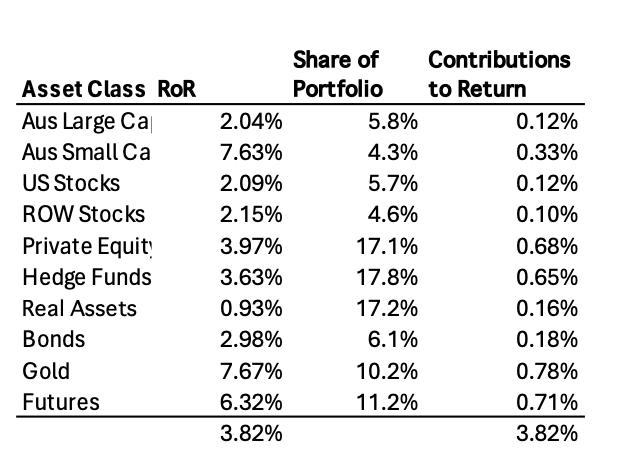
The contributions of the different investments and trades are as follows:


The returns on all the individual investments are net of foreign exchange movements. Again the biggest gain was in the CFS Geared Share Fund which is our biggest investment. Australian listed fund of hedge funds Everest Brown and Babcock continued to recover from a steep discount to book value but my other "deep value" Australian investments showed little movement or like Challenger Infrastructure and Clime Capital, declined.

Asset Allocation

Allocation was 41% in "passive alpha", 71% in "beta", 3% allocated to trading, 6% to industrial stocks, 3% to liquidity, 3% to other assets and we were borrowing 27%. Our currency exposures were roughly 56% Australian Dollar, 21% US Dollar, and 23% Other and Global. In terms of asset classes, the distribution was:


Due to the use of leveraged funds, our actual exposure to stocks was 118% of net worth. I slightly trimmed exposure to stocks as the market rose while increasing exposures to bonds and alternative assets by a little more, resulting in an increase in borrowing. Cash also increased, mainly due to setting up a new trading account with City Index.

Labels: ,

New Trading Goal for 2008

I'm upping my trading goal for 2008 from $9,500 to $15,000. This means making about $2000 per month for the rest of the year except in the month when we visit China. I've had realised short-term gains in shares and mutual funds (selling the fund, not getting a distribution) of more than $2,000 for the last three months. My futures results in the last two months has dragged performance down. I'm figuring that the new options trading strategy I'm implementing in the US (more on this some time soon) can make about $500 per month currently and CFD trading in Australia so far seems to be able to generate a similar amount perhaps. Then I only need $1,000 in stocks etc. to round the number out. $15,000 also represents a similar percentage improvement over 2007's result ($9,224) as 2007's represents relative to 2006 ($5,368).

Labels: , ,

Saturday, May 31, 2008

May Trading Results

May was another generally positive month for trading. Realised gains came in at $1,600 ($3,674 ytd):


It's feeling like this kind of rate might be sustainable. It's the fourth positive month in a row, which is a record - in the past I've only managed 3 positive months in a row. If I can maintain this, I could easily reach my annual goal of beating $9,500 (last year I realised $9,225). In my first week of trading CFDs I came in with a $A30 profit, which doesn't sound much but given the Australian market went nowhere, a 36% compound annual rate of return is pretty good I think :) This contrasts with my negative futures performance earlier in the month. As a result, my Interactive Brokers account lost 2.92% against a 5.99% rise in the NASDAQ 100 index, which I use as a trading benchmark. Gains in my U.S. taxable accounts (+Roth IRA) totalled about $1,400 or 1.6%. I'm still waiting for the figure on margin interest charged. As mentioned earlier in the month I reached the breakeven goal for these accounts and maintained that at month's end. But overall net worth slipped back below half a million USD. The full monthly report will be coming in a few days.

Labels: , ,

Friday, May 30, 2008

Sold Out of Safety Insurance


Sold my holding in SAFT. Held since August last year, received a few dividends watched the stock price go up, but though the company is cheap in terms of P/E it's not going anywhere. Didn't see them addressing their situation in the regulated MA car insurance market with falling regulated premia by making any initiative to invest in new products. Or do anything on the investments side. The price seems to have peaked for the time being and so I got out. Made a 22% annualized rate of return. Wish some of my other languishing investments could do as well as that :) For example, Sears, which I hold for some reason, while I wait for Eddie Lampert to pull a rabbit out of a hat. Released earnings, or rather "losings" this morning. Considering the surprise earnings shortfall the stock is not doing too bad... so far... I've only lost $55 since "investing" in this company, though I had a nice profit at one point...

P.S.

The oil market just went nuts (as did everything else) when the U.S. petroleum inventory report came out:


The oil price seems to be the main factor driving stock markets in the last few days...

Labels:

Thursday, May 29, 2008

Why Doesn't Australia Give More Incentives to Give to Charity?


We made some donations to help with the recovery from the Sichuan Earthquake. Half the money we gave through San Diego Zoo to help the Wolong Panda Reserve (both of us have been at different times to San Diego Zoo where there are both pandas and koalas). The other half we gave to the Australian Red Cross. We thought about giving money to this charity but contributions to it are not tax deductible while those to the Australian Red Cross are. Americans are used to being able to claim a tax deduction for a contribution to any non-profit. Here, charities must either be named in the Act of Parliament or meet very strict criteria. The Charles Foundation has chosen not to pursue tax deductible status even though it is an Australia based charity. Needless to say pretty much all foreign charities, including San Diego Zoo, are not eligible for tax deductibility in Australia.

I first became aware of these complications when I ran a small Australian non-profit - an academic society - we explored getting tax-deductible status - but it was just a non-starter. I think this discriminates in favor of large established charities - you can take a deduction for a contribution to an Australian university, but not to the educational efforts of our fledging academic society.

There are other strange restrictions on the tax deductibility of giving. In the US, giving appreciated assets to charities is really big. Buy a house for $1,000,000 and let its value rise to say $3,000,000. Leave it in your will to charity and your estate takes a $3,000,000 deduction against the value of the estate for estate tax purposes. In Australia, you can't donate property to charity if you've owned it for more than 12 months! We don't have an inheritance tax here either which also discourages giving (though I'm not a fan of inheritance taxes :) - though requiring people to give 10% of an inheritance to charity or pay an equivalent tax might be a good idea). Actually if the heirs donate the house within 12 months they'll be able to claim a $3,000,000 deduction in Australia but if they wait too long, they'll have to sell it, pay 23.25% tax on the $2 million gain (the top long-term CGT rate - unless they go and live in the house which will make the sale tax free) and then donate the remaining cash to charity, which they will be able to claim a deduction for. In the case of shares, you must hold them for 12 months or more (how weird is that?)... so a Warren Buffett could donate shares to charity and claim a massive deduction against his other income but not real estate or art works etc.

So it's not surprising that the U.S. has the highest level of charitable giving per capita in the world (which somewhat mitigates its low level of official foreign aid) and Australia a much lower level, though still ahead of many other developed economies.

Well, I don't know the answer to the question in the title, except that the government seems to trust people less on this here than the U.S. government does. Maybe it's due to the more secular nature of Australian society? After reviewing the tax deductions available for charitable giving in other countries, Australia is actually pretty generous compared to many.

A tip, donate in the name of the partner with the highest marginal tax rate if you are part of a couple. Don't donate as a couple if your tax rates differ.

Labels: , ,

Wednesday, May 28, 2008

Where Does BHP Make Its Money?

Today the price of oil is falling and though the U.S. stockmarket rose overnight the Australian stock market is down. Resource stocks are, of course, very important in the Australian market but while some resource companies produce oil, most need to oil to extract resources and so a fall in the price of oil reduces their costs substantially. The mining industry is very energy intensive (For example, this is why gold stocks are not up as much as the gold price over recent years). BHP is Australia's biggest company - it has a larger market capitalization than all the major banks combined (I think roughly 15% of the ASX capitalization). It is an oil producer, but how much of its profits does it derive from oil. The answer (for 2007) is of course in the company's annual report:


So 15% of revenue and 22% of profits come from petroleum. 51% of that revenue is profit - i.e. a 100% markup (and that was last year - all spot oil is priced at the cost of the most marginal source and those producers with cheap supplies make massive profits in an oil boom). So 22% of BHP's profits are increased by a rise in the price of oil but 78% are reduced. We don't know what the multipliers on each segment are though. Of course, Australia also has pure oil and gas producers like Santos and Woodside. But they are smaller. Santos has a capitalization of $11 billion and Woodside $45 billion (Commonwealth Bank is worth $56 billion). But a falling price of oil should have beneficial effects even on Australia's economy. I suppose investors are worried that other commodity prices will fall too. The materials and energy subindices are down 2.1% and 1.8% respectively as I write. Industrials, financials, and property are up. All others are down.

One thing that surprised me, is how little BHP made from "energy coal" - just $35 million.

Labels:

Tuesday, May 27, 2008

First CFD Daytrade

I completed my first CFD day trade for a profit of $1. Moving stops is not as fast as on Interactive Brokers as you need to click a confirm button after changing the price and the current stop price takes a little while to load. In any case extreme scalp daytrades aren't possible as the broker protects their bid-ask spread. It also would be nice if the current stop price was displayed alongside each open position rather than having to go to an "active orders" window to see them... So this is going to result in more considered day trades. Which maybe is a good thing :)

On the plus side City Index's charts reload nice and fast after changing the candle period. It's easy to flip between different time frames.

Currently the All Ords is oversold and would otherwise be on a model "buy". I was long overnight anyway. Europe was pretty much flat overnight and Japan and US futures are currently up. So going long seems a pretty good bet.

Labels:

Monday, May 26, 2008

First CFD Trade


My account was approved this morning and I got some money into my account - using a credit card it was there right away - more is on the way from Adelaide Bank via AnyPay. I got up to speed on the City Index interface and terminology. For anyone who's traded with a U.S. broker like Ameritrade or Interactive Brokers it won't take long to familiarize yourself. For those who've only placed simple market buys or sells on a broker like ComSec the learning curve will be much steeper. Futures traders will find CFDs simple to understand, maybe a little tougher if you've only traded shares before. The interface is pretty nice - not a lot different to Interactive Brokers. There are live streaming charts with some technicals- something ComSec charges an astronomical monthly fee for and requires you to down load software - though I'll probably stick with my IB charts for trading the Australian Index probably, but this could be very useful for other markets where I'm not willing to pay IB the fees (e.g. Australian stocks, European indices).

I successfully placed my first trade (my first attempt failed but City Index quickly fixed the problem by properly activating my account) - buying one ASX 200 index - the value is $1 * index so this is a $5747 position, which is totally anxiety free. I'm down $8 on my trade as I write including the initial 2 point spread. I put a stop at 5675 - which you enter together with the initial order. You can also use stop type orders to enter positions, but here the terminology is a little confusing. Just enter an "order" to buy at a price above the current market price to create a stop buy entry. If you put in an order to buy below the current market price that is the equivalent of a traditional futures limit order. You can't do a traditional limit order for a price above the current price and there would be no point in doing so. You can buy as much as you like up to the position limit at the price City Index is offering.

So far, my experience of City Index is very positive.

Labels:

Trading, Tax and Superannuation

Gradually, I'm getting up to speed on Australian taxation, retirement etc. A combination of reading the Australian Financial Review (horrible website only read the paper version) and Sydney Morning Herald (great website, The Australian's website sucks too but not as bad as the AFR) and then going and checking out the ATO website (not such a great website).

So if you are a trader you can record your profit and loss as "business income". If you are a derivatives trader (options, futures, CFDs (but not warrants)) then your income is automatically business income. For share traders it is a question of how business-like you are. But then it is going to be difficult I think to claim an long-term CGT discounts. So I don't want to be thought of as a "share trader" but instead investor in shares and trader in derivatives. Then you can deduct all expenses as they occur against your income. Any items that cost above $1000 need to be depreciated over time - e.g. a laptop. You can also claim rent, electricity etc. in proportion to floor area if you maintain a home office (I do). Investors need to apportion these types of expenses when they sell shares unless they can show that they need to do this to earn dividends in which case they can deduct them in the year they occur. Anyway, I plan to claim all these type of expenses against derivatives profit and loss and claim margin interest against dividends (make sure some of the stocks in each of your margin accounts pay dividends P.S. Remember to claim the tax withheld on foreign dividends).

It seems a trader can get an "Australian Business Number" and register for the GST. The advantage of this is that you can then claim credits for GST paid on inputs even if you are not charging GST on your sales (because they are "financial supplies"). I used to run an Australian non-profit and we signed up for the GST for just this reason. If you are in the 30% tax bracket, for example, you'll get back 100% of the GST paid, rather than the 30% you get back by claiming a deduction against income tax. The downside is you must now submit quarterly business activity and GST statements. I'm thinking, that for me at the moment it is hardly worth it - maybe a $100 or so gain if I bought a new computer say. The amount of GST on internet access or my business share of the electricity we use makes this hassle not seem worth it. But maybe an ABN is worthwhile for credit purposes etc. If you fill in a form and say you are self-employed they ask for your ABN....

To contribute to superannuation, at least 10% of your income must come from employment or business. I'll have a business loss this year so I can't contribute. I don't want to contribute much at this stage anyway but if your income is below $28,980 the government will contribute $1500 for the first $1000 you contribute to superannuation (with after tax money). This seems well worth it. From $28,980 to $58,980 the co-contribution gradually phases out. Hopefully, this will be relevant to me for the 2008-9 tax year and not so relevant in future years as I earn more :)

Once I do my 2007-8 tax return I'll understand all this a lot better I hope.

Labels: , , , ,

Sunday, May 25, 2008

Listed vs. Unlisted Property


Listed property includes REITs and other companies mainly involved in property that are listed on stockmarkets such as Westfield. Unlisted property and mutual and funds that are not stock market listed. The performance of these two types of investments can differ radically. Returns of unlisted property closely match those of direct investments in property while the listed investments fluctuate with the stock market and sometimes fluctuate more than the stock market. So much so, that these are almost two separate asset classes. According to Mercer Australian unlisted property returned 19.5% in the year to 31st March 2008 and 2.3% in the March quarter. On the other hand, the index of Australian REITs (shown above and which is dominated by Westfield) returned -22.8% and -17.8% respectively! Over the last 10 years A-REITs returned 9.8% vs. 12.8% for unlisted property.

We have a mixture of listed and unlisted property. I have 5% of net worth in the TIAA Real Estate Fund in my 403b. Since September 2002 it's averaged 11.1% p.a. with a Sharpe ratio of 3.8! It's only had three marginally losing months. The (unlisted) fund is directly invested in all kinds of property mainly in the US (one property in the UK at Canary Wharf). 13.5% of Snork Maiden's superannuation (Public Sector Superannuation Accumulation Plan) is in unlisted direct property. Besides that we have listed property investments including NCT (a mortgage fund in fact), CIF.AX (UK and global infrastructure) and about 3% of our holding of the Colonial First State Conservative Fund. In total we have 8.2% of net worth in property. The listed investments have been very volatile and erratic.

An article in the Australian Financial Review yesterday highlighted how much A-REITs have fallen recently but still argued that they are overvalued. I started to think about putting some money into them, but after this analysis (and given we already have a little via the CFS Conservative Fund, I'm less sure but may begin to put some of our contributions to Snork Maiden's managed funds into a listed property fund.

Labels: ,

Friday, May 23, 2008

How Does the American Economic Association Invest?

The American Economic Association (the World's top academic economics society) has an $18 million dollar potfolio. They're currently invested 85% in stocks and 15% in bonds. 55% of the total is in US equities and 30% in foreign equities. In April 2007 they reduced the bond percentage from 35% to 15%, which mirrors my more recent moves in my own and my Mom's account. But I made this move after the 2007-8 stock market correction not before it. Still their moves out of high-yield corporate bonds and the total bond market into investment grade bonds were well timed. As Mankiw notes it's surprising they don't have any real estate and I'd add any of the alternative assets such as private equity and hedge funds that the best performing university endowments have. Well, I guess they are a bit too strong believers in efficient markets to do anything like that...

Labels:

Market Inefficiency

Challenger Infrastructure Fund is down 22% today currently. Yesterday they reported that they sold their holding of Arqiva and ceased takeover talks with Arkmile. The stock fell a few cents yesterday. As reaction was muted to the ending of the takeover talks and I liked the Arqiva sale, I increased my position by 50%. And then today the stock collapses.... There is no new news reported today. So I can only assume that this is a delayed reaction to yesterday's news. In which case, this is good evidence that prices do not respond instantaneously to the news. People had all day yesterday to sell. Are these retail investors who only heard the news after their working day yesterday who are selling? Or is there some new news that hasn't yet been released to the market? There are some larger blocks transacting including one for 50000 shares (which didn't move the price but sold near the lows so far today). Lack of big blocks is not evidence of anything though...

Trading is very volatile. The stock is now down 17% only as I complete my post. In case there is something I haven't heard about I am not going to add further to my position.

Labels: ,

Thursday, May 22, 2008

City Index Seminar


I just got back from the City Index seminar. I was pretty impressed. The trading platform looks nice a lot of features similar to Interactive Brokers. The presenter used to be an FX trader at various investment banks and started a hedge fund of which he is now a limited partner. And they are giving seminar participants $250 for free if they open an account within a week of the seminar (obviously you needed to register for the seminar up front). I'll be opening an account tomorrow. If I can't make money trading with them I don't think I can make money short-term trading at all.

Labels:

Challenger Infrastructure Fund Update


The Challenger Infrastructure Fund announced that it sold its interests in Arqiva - a British provider of broadcasting infrastructure - and as a result is now debt free. Distributions will be paid from cash flow, rather than partly from debt. The paying distributions from debt model disturbed me a couple of years back - I reduced my position at the time but was willing to give the fund some benefit of the doubt. Since then, I've come to realise that this has been a common strategy amongst these Australian infrastructure funds and CIF is one of the least egregrious examples. On the other hand, the takeover offer from Arkmile is off for the moment.

I'm going to increase my position by 50% to a 1.8% portfolio weight.

Labels:

Are Financial Economists Seeing the Light on Technical Analysis?

Readers might be familiar with the following quotation from Burton Malkiel (A Random Walk Down Wall Street, 1996, p. 154):

“technical strategies are usually amusing, often comforting, but of no real value”

Proponents of "low cost index funds" typically believe this is true as do the majority of mainstream economists it would seem. The efficient market hypothesis argues that changes in market prices are purely random resulting from the arrival of previously unknown information to the market and that, therefore, there is no way to exploit past prices and volume data to predict changes in market prices. Then why do the majority of participants in foreign exchange markets as well as many in other markets use various variants of technical analysis to varying degrees? This question is addressed in the following paper:

Lukas Menkhoff and Mark P. Taylor, The obstinate passion of foreign exchange professionals: technical analysis, Journal of Economic Literature, Vol. XLV (December 2007), pp. 936–972.

The Journal of Economic Literature is one of the three or four most prestigious academic journals in economics and Mark Taylor is a top international macro-economist.

I'll leave it to the authors to explain, by drawing the following from their conclusion (pp966-967):

"A reading of the literature on the nature and use of technical analysis in the foreign exchange market allows us to draw up a set of stylized facts concerning its nature and use, and also to distinguish a number of arguments that have typically been adduced to explain its continued use.

Indeed, first and foremost among these stylized facts lies the continued and widespread use of technical analysis in the foreign exchange market. Research conducted in most of the major foreign exchange markets during the last decade or so reveals clearly that the use of technical analysis is an important and persistent phenomenon which is highly influential in the decision making of foreign exchange professionals. A similar situation emerges with respect to the profitability of technical analysis. It is beyond question that, for major flexible exchange rates and over longer time periods, the use of technical analysis may be used to provide very high returns. What is disputed, however, is whether the realization of these profits has to be bought at the cost of taking large risks and whether the profits can fully compensate for this additional risk.

A contribution that we have sought to make in this paper is in relating the available empirical evidence to several positions that have been developed in order to explain the continued use of technical analysis.

The first of these—interpreting the use of technical analysis as an indication of not-fully rational behavior—is difficult to reconcile with the fact that virtually all professionals in the market rely on this tool at least to a small degree. Moreover, there is no hard evidence showing that chartists are characterized by temporarily suboptimal behavior, or underestimate the risk involved or accept technical analysis as a marketing instrument.

The second position, relating profitability to foreign exchange interventions by the monetary authorities, is a little more satisfying in the sense that it suggests a more solid rationale for the use of technical analysis by rational agents. Also, some stylized facts concerning the profitability of technical analysis —namely that it tends to be more profitable during periods of official intervention —fit well with this position. There is, however, more recent evidence that suggests that it may be large exchange rate movements themselves that may be leading both intervention and technical analysis profitability or, equivalently, that the influence of technical analysis, by driving the exchange rate away from the level consistent with the fundamentals, may generate a rationale for official intervention, rather than vice versa, through the coordination channel of intervention effectiveness.

The third position, namely that technical analysis is simply an instrument in the processing and assimilation of market information, can also reconcile the importance of order flows and technical analysis to some degree. The main problem with this position, however, is that it does not explain the reason behind sluggish adjustment to news, preferences for round figures in order placement, etc.

Overall, therefore, perhaps the most satisfying explanation concerning the continued use of technical analysis seems to be position four, whereby technical analysis is seen as an instrument informing traders about nonfundamental price determinants. These forces are more important in the shorter-run, so for a full understanding of exchange rate dynamics, professionals need a combination of several tools, in particular both technical and fundamental analysis. This position also fits well with the stylized fact on the higher profitability of technical analysis in flexible exchange rate markets, as there is some indication that these markets may be characterized by a degree of volatility that is hard to explain by fundamentals alone (Robert P. Flood and Rose 1995).

This still leaves open, however, the question of risk-adjusted profitability. If technical analysis has some rationale in the sense of being able to generate profitable trading rules, why does the market process not assimilate or arbitrage these profit opportunities away? The answer may be the same as with fundamental analysis: in well functioning markets one would expect that profit opportunities will be exploited up to an extent where agents feel appropriately compensated for their risk. To take open positions is inherently risky, whether the decision is based on fundamental or technical considerations.

What is perhaps most striking from our reading of the literature, however, is that technical analysis remains a passionate obsession of many foreign exchange market professionals; it is clearly an intrinsic part of this market. For academic researchers, this means that technical analysis must be understood and integrated into economic reasoning at both the macroeconomic and the microstructural levels. For market practitioners, it means that technical trading strategies should be constantly evaluated as potentially important tools in the search for excess returns. "

In other words, technical analysis works and produces significant profits because market prices convey information that is not embodied in the known fundamentals, but it is an open question as to whether exploiting those profit opportunities means taking on more apparent risk, which the majority of market participants are unwilling to do. Even if the market is more or less efficient, someone has to move the market towards the equilibrium and many participants in the foreign exchange markets are actively trying to avoid risk by hedging away their foreign exchange liabilities rather than maximize their profitability.

Labels: ,

Pullback in Progress


It's unusual to have more than two big down days in the US market recently without some sideways or slightly up action. So expect smaller falls or some rebound Thursday and Friday. The model is forecasting a new uptrend starting on Tuesday (after Memorial Day), though that depends on the stochastics staying above 20 which would require a little rebound in the next couple of days already and what non-US markets do on Monday and Tuesday. My most likely scenario is that an ABC wave is nearing completion which started a couple of days into the month and that what we'll see in coming weeks is more sideways action with three part waves up and down. But of course, anything could happen. The analogous correction in 1991 was very sharp with less down days punctuating the bigger down days:


Something like this is a definite possibility if there isn't much of a bounce in the next 2-3 days.

Labels:

Wednesday, May 21, 2008

Bekaert


Bekaert has returned 35% since bought on 17 January. The price is close to analysts' targets and as I blogged earlier there may be some downside in the market in the near future (though my bet is that it won't be very significant. I now know why my friend thinks this is a good investment or trade. I'm skeptical about how important that factor can be for the company and how sustainable a source of profit it will be. On the other hand that doesn't mean I think the stock is overvalued. Sales recently increased more than expected.

So I sold 1/4 of my shares to return my position to a 1% share of net worth. We booked a €250 profit on that trade. We also received a €110 dividend today (tax was withheld, but I should be able to claim that back from the Australian tax authority). The two together just about paid for the chair :P

Labels:

Sometimes it's Worth Paying for a Good Product

We just bought an office chair for use at home. A few months ago I ended up with an inflamed sciatic nerve from sitting on a poorly designed, but attractive, chair at my desk. I went eventually to a physical therapist who diagnosed the problem correctly, gave me some exercises to do and told me to get a new chair. In the meantime, I've been sitting on an exercise ball when working at my desk, but was beginning to tire of that.

The search started off at OfficeWorks - an Australian clone of Staples. They had a good value chair:


(it actually cost $195 in t