Showing posts sorted by date for query "managed futures". Sort by relevance Show all posts

Tuesday, October 06, 2026

2025-26 Tax Returns

Here is a summary of my 2025-25 Australian tax return (all numbers in Australian dollars):

You can find previous years here. Salary was up massively due to the redundancy package. I only actually worked for 5 months of the year. Also, $100k of the redundancy package was totally tax free and is not included in my tax return. Also, I started to realise more capital gains–up 129%. Dividends increased more modestly and total income was a record $370k, up 41%. 

Deductions also increased this year, mainly because of the personal superannuation deduction of $13k. In theory you can contribute up to $32.5k per year in concessional superannuation contributions. But I had already used more than half the cap in employer superannuation contributions. I also loaded up on employment deductions before quitting :). Deductions totalled $43k, up 52%.

So, in summary taxable income was $327k, up 39%. My estimate of tax payable depends on me understanding the correct interaction of the tax on the redundancy package and the tax on my regular income. I could be wildly out on the $95k. But I have $14k in franking credits from Australian dividends and a disappointingly small venture capital offset to reduce that tax down to an estimated $80k. I estimate I will owe $2.5k in tax :(. 

Div 293 tax is an extra 15% tax on superannuation contributions if you earn more than $250k. I doubt I will ever need to pay that again.

Here is a summary of Moominmama's tax return:

She had big jumps in Australian dividends and foreign source income. The latter is mainly gains on Australian Dollar futures.

As a result gross income came in at $116k, up 6%. Deductions were down by 26% due to keeping more money in our offset account, which reduces mortgage interest. Yes, it is tax-deductible if you do debt recycling.

As a result, taxable income was up 39% to $75k. Gross tax of $15k is offset by $10k in tax credits to result in net tax of $5k. She should get a refund of c. $1,700. 

Separate to all this is the tax return for our self-managed super fund. I still need a tax statement from Assetora, but the deadline for SMSF's to submit tax returns is much later. 

Friday, October 02, 2026

September 2026 Report

After five up months, September was a down month. The Australian Dollar fell from USD 0.7164 to USD 0.6983. So, our Australian Dollar returns are higher than our USD returns. 

Here is the performance of our benchmarks (total returns including dividends):

US Dollar Indices

MSCI World Index (gross): -1.08%

S&P 500: -0.35%

HFRI Hedge Fund Index: 0.08% (forecast)

Australian Dollar Benchmarks

ASX 200: -2.10%

Target Portfolio: 0.40% (forecast)

Australian 60/40 benchmark: -0.90%

In Australian Dollar terms we lost 1.52% and in US Dollar terms 4.01%. As a result we only outperformed the ASX 200 benchmark. The SMSF returned -2.64%, underperforming both Unisuper and PSS(AP) which lost 0.85% and 0.46%, respectively. Here is a report on the performance of investments by asset class:

The asset class returns are in currency neutral and gross asset terms and do not include investment expenses such as margin interest, and so the total differs from the Australian Dollar returns on net assets mentioned above. All asset classes apart from futures and commodities lost money. Within futures and commodities, cryptocurrency and managed futures made positive contributions and Australian Dollar futures detracted. Hedge funds had both the worst return and detracted the most. However, the Acadian Global Long-Short Fund was one of the best performers this month. There is a lot of variability within these asset classes.

Things that worked well this month:

  • We had 5 investments that gained AUD 10k or more : Silvia (SVIA, 21k), Bitcoin (18k), Acadian Global Long-Short (13k), L1 Gold Fund (LGF.AX, 10k), and ZIM (10k).

What really didn't work:

  • We had 9 investments that lost AUD 10k or more: Gold (34k), Pershing Square Holdings (PSH.L, 27k), Tribeca Global Resources (TGF.AX, 26k), Regal Investment Fund (RF1.AX, 16k), 3i (III.L, 15k), Australian Dollar Futures (15k), L1 Global Long-Short Fund (GLS.AX, 14k), Pengana Private Equity (PE1.AX, 11k), and URF (10k).

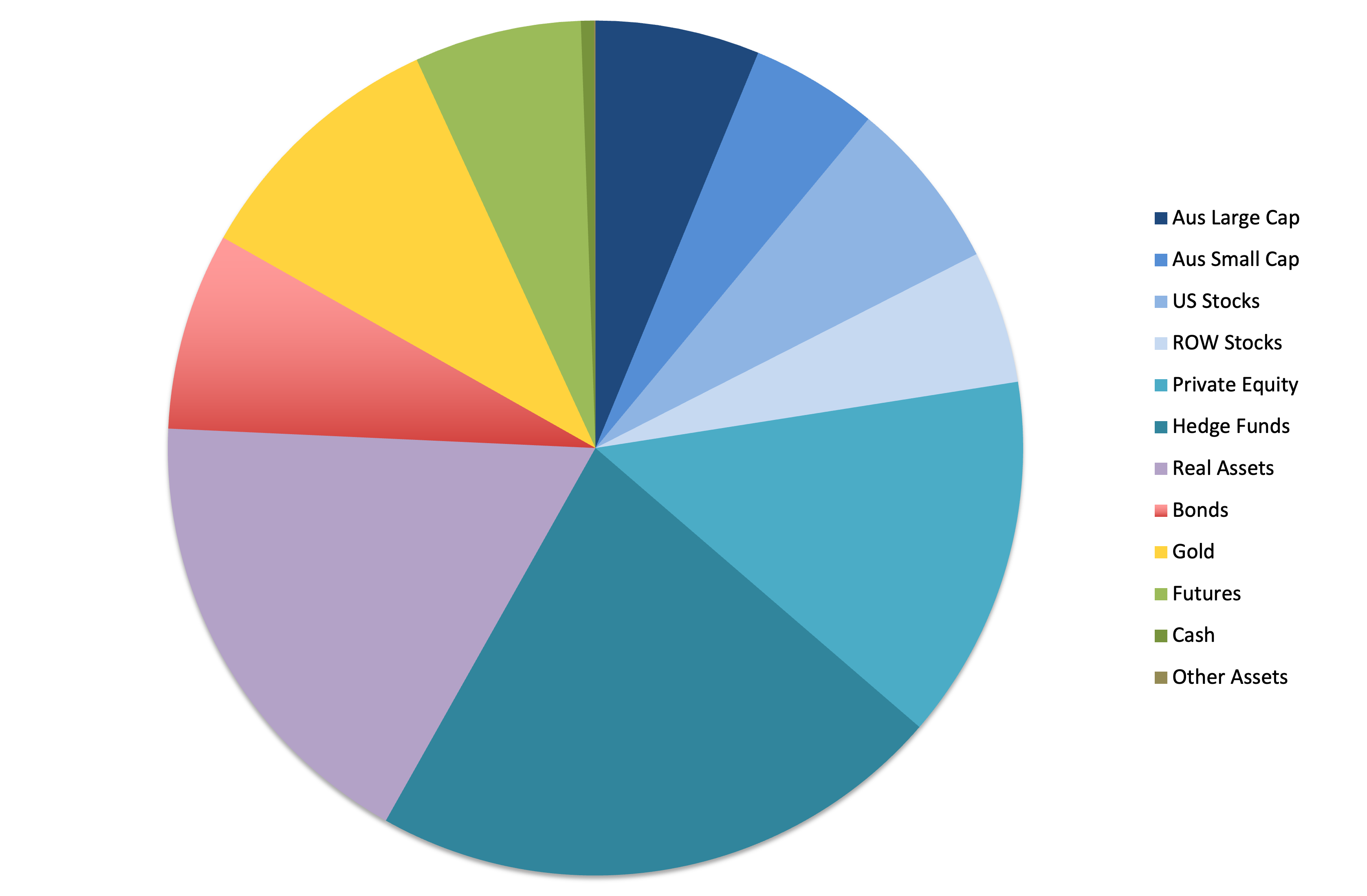
Our distance from our new target allocation increased slightly. Our actual allocation currently looks like this:


Around 70% of our portfolio is in what are often considered to be alternative assets: real estate, art, hedge funds, private equity and credit, gold, and futures. A lot of these are listed investments or investments with daily liquidity, so our portfolio is not as illiquid as you might think.

Moominmama receives employer superannuation contributions every two weeks. There will still be capital calls from Aura Venture Fund II and III. I am receiving monthly pension payments from both Unisuper and our SMSF, totalling AUD 6,770 per month. I made the following moves:

  • I invested a total of USD 3,000 in two startups on Angellist.  
  • We continued to add to our "crypto basket" including 3,500 shares of IBTC.AX (= 0.35 bitcoin), around AUD 48k of QETH.AX (ethereum ETF), 3k shares of SVIA (fomerly BRR), and establishing a 50k share new position in Defi Technologies (DEFI.NE/DEFT), which we also invested in in the previous cycle. We now have 5.4% of net worth in this basket.
  • We added another 1,000 ZIM shares. 
  • We sold the following shares to fund this build up: 369 AMLP, 1,000 PBDC (whole position), 2,000 WCMQ.AX, 7,000 HM1.AX., and around 15k CDO.AX shares.
  • I also sold 50k L1 Gold Fund (LGF.AX) shares after receiving 30k in the rights issue. This brought our CommSec margin loan down to AUD 43k. Given its high interest rate, I plan to use it for trading rather than long-term investment going forward. This is part of the "restructure".
  • Continued to trade options on TWE.AX and did a couple of other stupid short-term trades that luckily didn't lose much money.

Here are the income and spending accounts * for this month ($ is Australian Dollar):

Other income includes Moominmama's salary and net employer superannuation contributions but also the tax paid by the SMSF. Spending was typical of non-school-fee months at AUD 8.2k. This number does not include our mortgage payments, which are regarded here as saving (principal) and investment costs (interest) but it does include depreciation on our car, which is a few hundred dollars a month now. We lost $111k investing. Retirement net contributions (Other income retirement) were $516. The transfer out of retirement is my pensions. Tax credits on non-superannuation accounts were $4k. As we report superannuation investment returns on an estimated pre-tax basis, the implicit tax ($386) needs to be deducted to get to the change in net worth.

Dissaving amounted to $4.3k, which is well within the 4% rule limit of AUD 23k.  

As a result of all this, net worth fell by AUD 119k to AUD 8.567 million.

* Results are shown separately for retirement and non-retirement accounts as well as housing, which nowadays doesn't have much activity. The grey shaded rows are additional notes. Total investment income is split into investment income before exchange rate moves and the contribution of exchange rates. Current other income is non-investment income including salaries and net income tax returns, while on the retirement side it includes employer superannuation contributions minus superannuation contribution tax and all SMSF tax payments to the ATO. Investment income is shown pre-tax. Tax credits include franking credits on Australian dividends etc. in non-retirement accounts and the SMSF and imputed tax on industry superannuation returns. These are taken away from investment income to get changes in actual net worth. Inheritances include gifts from relatives. Saving is from non-investment income, transfers, and inheritances not investment income.

Tuesday, July 07, 2026

Large Distribution from Macquarie Winton Global Alpha

I didn't realise, but the Winton Global Alpha Fund (managed futures) rose 22% this Australian Financial Year. And then on 30 June they paid out most of the gain as a distribution. Almost AUD 36k for us! On the spot, I decided to reinvest AUD 20k. The fund has been doing well, so, we don't really want to greatly reduce our position. On the other hand, it might make sense to take some chips off the table, and eventually we need cash. But this is enough to pay my current SMSF pension for almost 11 months... So, keeping a 7% yield and reinvesting the rest sounded about right. This fund is in the SMSF because of its propensity for big non-tax advantaged payouts like this. 

Saturday, July 04, 2026

June 2026 Report

The Australian Dollar fell from USD 0.7185 to USD 0.6909 and gold fell steeply. International stock markets lost a little and the Australian market still managed to underperform in USD terms, though it gained in AUD terms. The following results are preliminary–we won't get venture and art results for a while.

Here is the performance of our benchmarks (total returns including dividends):

US Dollar Indices

MSCI World Index (gross): -0.77%

S&P 500: -0.95%

HFRI Hedge Fund Index (forecast): -0.16%

Australian Dollar Benchmarks

ASX 200: 0.73%

Target Portfolio (forecast, depends on HFRI): -0.03%

Australian 60/40 benchmark: 1.36%

In Australian Dollar terms we gained 0.51% and in US Dollar terms we lost 3.35%. The only benchmark we outperformed was the target portfolio. The SMSF also underperformed, losing 0.67% while Unisuper gained 2.05% and PSS(AP) 2.23%. Why did the target portfolio have weak performance this month? Gold detracted 0.82% of return and venture capital 0.84%. If we add those two back, the return would be 1.63%, which is between the ASX 200 and MSCI (AUD) returns. We outperformed the target largely due to not experiencing those negative venture returns.

Australian superannuation funds report performance for the Australian financial year which ends on 30 June. For this period, the SMSF gained 12.2% (pretax), Unisuper, 8.9%, and PSS(AP) 11.3% (estimated pretax). So, we beat both benchmarks.

Here is a report on the performance of investments by asset class:

The asset class returns are in currency neutral terms and gross asset terms and do not include investment expenses such as margin interest, and so the total differs from the Australian Dollar returns on net assets mentioned above. Gold and futures lost a lot and private equity a little. All other asset classes gained with rest of world stocks having the highest return and Australian large cap, hedge funds, and US stocks each contributing about a quarter of a percent of returns.

There was a lot of dispersion of returns, with lots of big winners and big losers. Things that worked well this month:

  • Eight investments made AUD 10k or more: L1 Global Long-Short (GLS.AX, 49k), Acadian Global Long-Short (24k), Unsiuper (17k), 3i (III.L, 16k), Regal Investment Fund (RF1.AX, 14k), PSS(AP) (11k), Regal Partners (RPL.AX, 10k), and WCM Global Quality Active ETF (WCMQ.AX, 10k).

What really didn't work:

  • Five investments lost more than AUD 10k: Gold (-59k), Pershing Square Holdings (PSH.L, -40k), Australian Dollar Futures (-30k), Pengana Private Equity (PE1.AX, -22k), Tribeca Global Resources (TGF.AX, -22k).

Our distance from our target allocation increased a little. Our actual allocation currently looks like this:


Almost 70% of our portfolio is in what are often considered to be alternative assets: real estate, art, hedge funds, private equity and credit, gold, and futures. A lot of these are listed investments or investments with daily liquidity, so our portfolio is not as illiquid as you might think.

Moominmama receives employer superannuation contributions every two weeks. We also make monthly concessional contributions to Moominmama's superannuation to reach the annual cap on contributions. There will still be capital calls from Aura Venture Fund II and III. I am receiving monthly pension payments from both Unisuper and our SMSF totalling AUD 5,150 per month. I made the following other moves this month:

  • I did invest in five new startups via Angellist! So, I was busy reading all the investment memos and pitch decks of companies I didn't end up investing. One of the startups is a secondary sale of Polymarkets shares, which is a private company, but beyond the startup phase.
  •  I sold 10k Regal Investment Fund (RF1.AX) shares and bought 20k Pengana Private Equity (PE1.AX) shares, which were undervalued after the SpaceX IPO. SpaceX is their biggest holding. My theory, is that people investing in Pengana's new AI fund, may have been sellling their PE1 shares.
  • I bought 1k shares in Metrics Opportunities (MOT.AX)–a listed private credit fund. 
  • I bought 17.5k shares of Treasury Wine Estates (TWE.AX). 
  • I sold 50 Berkshire Hathaway shares and 1,000 ASX 200 ETF (IOZ.AX) shares to fund it. 
  • I bought 30k shares of the L1 Gold Fund (LFG.AX). 
  • I added to some of my trading positions at Masterworks after another painting realization.
  • I bought a few additional shares of one of the NDIS properties I am invested in at Assetora using accumulated investment income there. 

As you can see, while we have so much cash in our offset account, I am tending to still reinvest some of our investment income.

 Here are the income and spending accounts * for this month ($ is Australian Dollar):

Other income includes Moominmama's salary and employer superannuation contributions but also the tax paid by the SMSF. Other retirement number is negative this month because I submitted a  "Notice of Intent" to claim a tax deduction to Moominmama's employer super fund, which triggered 15% tax on the $22.5k of voluntary contributions I had made this year to it. Moominmama bought a new laptop for $2197, which her employer reimbursed–it is counted both in other income and spending. So, spending was a bit higher this month. This number does not include our mortgage payments, which are regarded here as saving and investment costs. Dissaving amounted to $8k, which is way within the 4% rule limit of AUD 23k. We gained $35k investing, mostly from retirement accounts and all because of the fall in the Australian Dollar. We got an estimated $8k in tax credits and implicit tax on our employer super, which are included in pretax investment returns but have to be deducted to get to the change in net worth. As a result of all this, net worth rose by AUD 19k to AUD 8.246 million.

* Results are shown separately for retirement and non-retirement accounts as well as housing, which nowadays doesn't have much activity. The grey shaded rows are additional notes. Total investment income is split into investment income before exchange rate moves and the contribution of exchange rates. Other income is non-investment income including salaries, employer superannuation contributions, net tax returns minus superannuation contribution tax and all SMSF tax payments to the ATO. Investment income is shown pre-tax. Tax credits include franking credits on Australian Dividends etc. in non-retirement accounts and the SMSF and imputed tax on industry superannuation returns. These are taken away from investment income to get changes in actual net worth. Inheritances include gifts from relatives. Saving is from non-investment income, transfers, and inheritances not investment income.

Friday, June 13, 2025

Switching from Generation Global to Acadian Global Long-Short

Generation Global Fund is one of our longest held investments. I first invested in April 2008. It was a good fund but has been weaker recently. I also invested in the Acadian Global Long-Short Fund back in April 2008. But I exited in 2012 because it had underperformed and we needed the cash for our house-buying fund.

It turns out that that was about when the fund started to outperform. Its overall track record since inception has now been very good with a beta of 0.3 to the MSCI All Country World Index and an alpha of 7.7%. In the last 5 years it has done even better:


Beta has been 0.3 over the last five years too, while alpha has been even higher. I noticed because of an article in The Australian. I then went and downloaded the data from Colonial First State (CFS) and did the analysis. So, I am switching from Generation to Acadian. This will tilt the portfolio away from an overweight on US stocks and back towards hedge funds. Though this hedge fund has a strong weight on US stocks itself.

P.S. 14 June 2025

I have also decided to switch from Aspect Diversified Futures to this Acadian Fund in our SMSF. Aspect was flagged as an underperformer in our Investments Review.

I haven't managed to do either transaction yet. I found that the manager still has Moominmama's old mobile number and to change your phone number you need to use your existing phone as authentication. You can log into the account using email for authentication. So I placed a secure request inside the account to change the number. They are just refusing to do the switch at "this time" in the SMSF account. Will try again on Monday and phone them if it doesn't work.

P.P.S. 17 June 2025 

I phoned CFS and they called me back. It turns out that CFS's "mezzanine" investments each have separate PDSs (prospectuses) for each fund manager. So, I had to make a new application for the Acadian Fund rather than a switch. I have now done that. So, we are halfway there. By the way, this new hedge fund investment means I am again tweaking the target portfolio to make sure it remains a good benchmark. I am raising hedge funds to 15%, reducing RoW stocks to 4%, Australian large cap to 9% and Australian small cap to 4%.

Tuesday, June 03, 2025

May 2025 Report

In May, the Australian Dollar rose from USD 0.6392 to USD 0.6431 meaning that USD investment returns are a bit better than AUD investment returns. Stock markets rose (total returns including dividends):

US Dollar Indices

MSCI World Index (gross): 5.81%

S&P 500: 6.29%

HFRI Hedge Fund Index: 1.30% (forecast)

Australian Dollar Benchmarks

ASX 200: 4.38%

Target Portfolio: 3.70% (forecast - depends on HFRI result)

Australian 60/40 benchmark: 3.17%

We gained 2.27% in Australian Dollar terms or gained 2.90% in US Dollar terms. So the only benchmark we are expected to beat is the HFRI. We underperformed the target portfolio because of the very high private equity returns of 14% for venture and 11% for buyout that fed into it. By comparison we earned 0.89% on our private equity investments.

Here is a report on the performance of investments by asset class:

The asset class returns are in currency neutral terms as the rate of return on gross assets and do not include investment expenses such as margin interest, and so the total differs from the Australian Dollar returns on net assets mentioned above. All asset classes but gold had positive returns with the strongest returns from Australian small cap and the largest contribution from hedge funds, mainly due to a rebound in Pershing Square Holdings.

Things that worked well this month:

  • Six investments gained more than AUD 10k: Pershing Square Holdings (PSH.L, 37k), Unisuper (23k), PSS(AP) (15k), Regal Partners (RPL.AX, 14k), WCM Global (WCMQ.AX, 12k), and Bitcoin (12k).

What really didn't work:

  • Regal Investment Fund (RF1.AX) lost AUD 10k.

Here are the investment performance statistics for the last five years:

The top three lines give our performance in USD and AUD terms, while the last three lines give the same statistics for four benchmarks. This month, we have added the Vanguard 60/40 ETF portfolio to the set of benchmarks. The middle block gives our performance relative to the indices. 

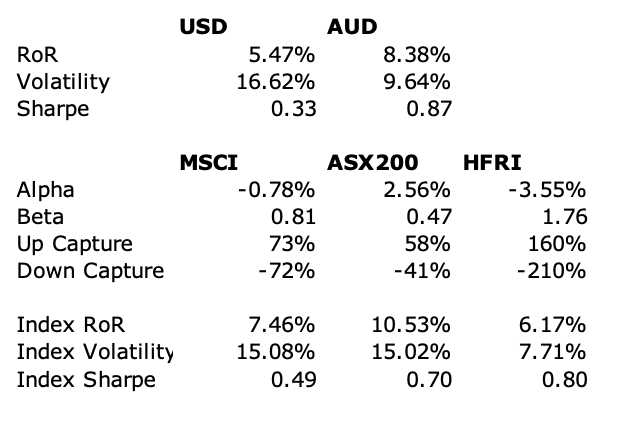
These are now measured from the end of May 2020. Our alpha relative to the ASX200 fell to 3.1% with a beta of only 0.48. We still have much lower volatility, resulting in a information ratio of 1.43 vs. 1.11. We capture much less of the downside moves than the upside moves in the market. We also have very good performance relative to the Vanguard 60/40 portfolio with the same volatility but 4% p.a. more return. But as we optimize for Australian Dollar performance, our USD statistics are much worse. We do beat the HFRI hedge fund index in terms of return, but at the expense of much higher volatility. Our USD volatility is at least less than that of the MSCI index, but our return is more than three percentage points lower.

We moved strongly towards our target allocation as we completed redeployment of cash from the sales in April. Our actual allocation currently looks like this:

About 70% of our portfolio is in what are often considered to be alternative assets: real estate, art, hedge funds, private equity, gold, and futures. A lot of these are listed investments or investments with daily liquidity, so our portfolio is not as illiquid as you might think.

We receive employer superannuation contributions every two weeks. We make an annual concessional contribution to Moominmama's superannuation to reach the annual cap on contributions. We contribute USD 10k each quarter to the Unpopular Ventures Rolling Fund and less frequently there will be capital calls from Aura Venture Fund II. I am now receiving TTR pension payments from both Unisuper and our SMSF and contributing more than the total of these back to my superannuation accounts. (around AUD 4k net contribution per month). It was another busy month. I made the following additional moves this month:

  • I made a UK pension contribution for the 2024-25 financial year.
  • I bought 200 shares of Berkshire Hathaway B (BRK/B). I think Greg Abel may find better things to do with the cash pile than Buffett did and, as he is an operations guy, rationalize some of the existing subsidiaries.
  • I bought 40k shares of a Metrics private credit LIT (MOT.AX). The idea is that this will fund TTR pension payouts next financial year. It is trading about 7% below NAV so has some margin of safety.
  • I sold 1,000 shares of the gold ETF PMGOLD.AX. We hold 13k shares now.
  • I bought net 2.5k more shares of an ASX200 ETF (IOZ.AX). Yes, I'm getting more comfortable with passive investing for the long equity portion of our portfolio. We now have 3k shares.
  • I bought 2,000 more shares of the WCM Global Quality managed ETF (WCMQ.AX). We now have 13k shares.
  • I bought 10k more shares of the Pengana private equity LIT (PE1.AX). We now have 87k shares.
  • I bought net 60k more shares of the WAM Capital LIC (WAM.AX). We now have 100k shares.
  • I bought 1,175 more shares of a bitcoin ETF (IBTC.AX). We now have 8k shares. Roughly 0.8 BTC.
  • I bought 300 more shares of 3i (III.L) after it sold off on what looks like a great earnings report. Earnings on stated NAV were 25% up 25% on the previous year. It trades way above NAV, but that is because NAV is stated pretty conservatively I think. We now have 3,800 shares.
  • I bought 500 more shares of Pershing Square Holdings (PSH.L). Their reduction of their position in Universal Music, increase in positions in tech stocks, and possibility of strong performance for Fannie Mae and Freddie Mac together with the price being way below NAV, encouraged me to add to the position. We now have 5,500 shares.


Friday, May 02, 2025

April 2025 Report

April was our third down month in a row, though the loss was less than in the previous two months. I also went through something of a mental health crisis involving insomnia. I am already beginning to feel better. As a result of the crisis I closed all our investments listed on North American markets. I also decided to continue in my job on a full-time basis for now rather than quit or go part time. Also, because the information ratio of our SMSF is now lower than both Unisuper and PSS(AP), I am redirecting our non-concessional contributions to the latter funds instead of to the SMSF. On the other hand, the SMSF's rate of return since inception still beats the professionally managed funds (8.4% p.a. vs. 5.7% and 6.6%). But I got that extra return by taking on more risk. I now think that was too much risk for my health.
 
The Australian Dollar rose from USD 0.6240 to USD 0.6392 meaning that USD investment returns are better than AUD investment returns. Stock indices and other benchmarks performed as follows (total returns including dividends):

US Dollar Indices

MSCI World Index (gross): 0.98%

S&P 500: -0.68%

HFRI Hedge Fund Index: 0.18% (forecast)

Australian Dollar Benchmarks

ASX 200: 3.63%

Target Portfolio: 0.58% (forecast - depends on HFRI result)

Australian 60/40 benchmark: 0.48%

We lost 0.93% in Australian Dollar terms or gained 1.49% in US Dollar terms. So we outperformed the US Dollar indices and underperformed the Australian Dollar benchmarks.

Here is a report on the performance of investments by asset class:

The asset class returns are in currency neutral terms as the rate of return on gross assets and do not include investment expenses such as margin interest, and so the total differs from the Australian Dollar returns on net assets mentioned above. Performance was mixed, with rest of the world stocks having the worst rate of return and the most negative contribution to overall return followed by Australian small cap in terms of rate of return. Gold performed best, but private equity made the most positive contribution to total return (with gold in second place).

Things that worked well this month:

  • 3i (III.L) was the star performer, gaining AUD 45k. Gold gained AUD 32k and Australian Dollar Futures 10k.

What really didn't work:

  • Defi Technologies (DEFI.NE) was the biggest loser at AUD 52k. Bitcoin lost 33k, Pershing Square Holdings (PSH.L) 18k, Aspect Diversified Futures 11k, Regal Partners (RPL.AX) 12k, and Winton Global Alpha 10k.

Here are the investment performance statistics for the last five years:

The top three lines give our performance in USD and AUD terms, while the last three lines give the same statistics for three indices. The middle block gives our performance relative to the indices. 

These are now measured from the end of April 2020 and so are quite different to last month's data as they include one month of the post-pandemic rebound in the baseline value. Our alpha relative to the ASX200 fell to 3.15% with a beta of only 0.49. We still have much lower volatility, resulting in a Sharpe ratio of 1.12 vs. 0.93. We capture much less of the downside moves than the upside moves in the market. But as we optimize for Australian Dollar performance, our USD statistics are much worse. We do beat the HFRI hedge fund index in terms of return, but at the expense of much higher volatility. Our USD volatility is at least less than that of the MSCI index, but our return is almost three percentage points lower.

We moved away from our target allocation partly because we changed the allocation and partly because of our trades. Our actual allocation currently looks like this:

About 70% of our portfolio is in what are often considered to be alternative assets: real estate, art, hedge funds, private equity, gold, and futures. A lot of these are listed investments or investments with daily, monthly, or quarterly liquidity, so our portfolio is not as illiquid as you might think.

We receive employer superannuation contributions every two weeks. We make an annual concessional contribution to Moominmama's superannuation to reach the annual cap on contributions. We contribute USD 10k each quarter to the Unpopular Ventures Rolling Fund and less frequently there will be capital calls from Aura Venture Fund II. I am now receiving TTR pension payments from both Unisuper and our SMSF and contributing more than the total of these back to our superannuation accounts. (around AUD 4k net contribution per month). I made the following additional moves this month:

  • I sold all our position in Defi Technologies (DEFI.NE and DEFTF). We made a 90%+ IRR on the investment, which is some consolation, despite giving up the potential for more profit.
  • We sold all our position in the Fidelity Bitcoin ETF (FBTC) (for a 17% IRR) and opened a much smaller position in Australia in the Monochrome Bitcoin ETF (IBTC.AX). Our allocation is now just 1.7% of net worth, which removed my anxiety entirely. My mistake was buying too much bitcoin at relatively high prices after first entering the investment at a reasonable price. This made me anxious about losing money and I sold out near a local low. Maybe we will do better next cycle. As a result of these two moves, we now have a huge pile of cash to re-invest - near AUD 700k.
  • I bought 500 shares of IOZ.AX, an ASX200 ETF. This is to begin to match the new target allocation that has a larger allocation to long-only shares. 
  • I bought 40,000 shares of WAM Capital (WAM.AX), which is a small cap Australian stock fund managed by Wilson Asset Management. It has a very good track record. Another move to match the new target. We will gradually buy into these positions, which are both still very small.
  • I did a quick trade of 5,000 RF1.AX shares (bought these by mistake in the wrong account!). I bought 15,000 RF1.AX shares in the SMSF.

Saturday, April 26, 2025

Update to Target Portfolio

It's time to update the target portfolio again. The last time I posted about this was here I think. The main change is that it is getting harder to find good quality accessible hedge funds. Our allocation to Pershing Square Holdings (PSH.L) is 6.3% of net worth, so I don't really want to increase that. Regal Investment Fund (RF1.AX) keeps reducing the share of hedge funds in their allocation. Tribeca Global Resources (TGF.AX) and to some degree Cadence Opportunities(CDO.AX) have been poor performers. The L1 Long-Short Fund (LSF.AX) is a possibility, as it has outperformed RF1 over 5 years. It didn't perform well in 2023 and 2024, but is doing well so far in 2025.

Also, managed futures have done poorly in the latest crisis, though often they perform better after a crisis. So, we are cutting allocations to these asset classes and increasing the allocation to long-only shares. This also reflects that I am planning on allocating more to our employer superannuation funds - Unisuper and PSS(AP). We also suddenly have a lot of cash. Reasons for these two things will come in a later post.

The following does not include cash in our regular bank accounts, which is around 3% of total assets currently. 

At the top level 60% is allocated to equity and 40% to other.

Equity: 27.5% long-only, 20% private equity, 12.5% hedge funds. 

Long-only: 10% Australian large cap, 5% Australian small cap, 8% US, 4.5% ROW.

Private equity: 10% venture, 10% buyout, SPACs etc.

We will try to balance private equity and hedge funds between Australian and foreign too.

Other: 15% real assets (real estate, art etc.), 10% gold, 7.5% futures (managed futures, bitcoin, direct futures, cash in trading accounts), 7.5% fixed income (bonds and private credit). 

At the moment we are overweight gold, cash (classified as futures), and private equity, and underweight the other asset classes.

Sunday, March 30, 2025

Investments Review 8: Developing Alternative Investments

The last installment of the Investments Review, though, actually, there will be an action plan coming up!

Bitcoin Portfolio share: 11.9% IRR: 40%. We hold Bitcoin across the SMSF and our individual Interactive Brokers accounts. I first got into Bitcoin in 2019 when CME futures were introduced, thinking it would be good to trade it. I made some money and gave some back. Then last year, when the spot ETFs were launched I decided to do longer term trading. I got in a bit late and made things worse for myself by buying more when the price had already risen into the $70k range. Then the late 2024 surge generated some profit, which has been partially given back at this stage. The current game plan is to sell the ETFs sometime this year, based on market indicators. I am beginning to think of switching then to shorter term trading again, we will see.

Winton Global Alpha Portfolio share: 3.3% IRR: 4%. This is my larger managed futures investment. We hold it in the SMSF as it is not tax efficient. It didn't do well when interest rates were low and especially going into the pandemic. Then there was a big surge, as interest rates increased. These investments do well in high interest rate/high inflation environments. Recently, I redeemed some of the investment. Possibly, I should set distributions to be paid out rather than re-invested.

Masterworks Portfolio share: 2.6% IRR: 3%. I started investing through this fractional art investing platform in 2018. I have had a three profitable "exits" but the remainder of the portfolio is mostly down and I haven't added more. The IRR is pretty low. I will wait for this to gradually wind down I think.

Aspect Diversified Futures Portfolio share: 1.9% IRR: 12%. I invested in this (through Colonial First State) to diversify my managed futures holdings. We hold this in the SMSF too. The period of rising interest rates was good, but it is not doing so well since interest rates started to decline. Possibly, I should set the distributions to be paid out rather than be re-invested.

CD3 Portfolio share: 1.6% IRR: 13%. This ASX listed fund mostly invests in US private equity. It is also in the SMSF. It is trading at a large discount to NAV and has a good IRR. The portfolio is quite mature and exits are occurring. So, I think this is a good investment that I will continue to hold and maybe add more to.


Wednesday, March 05, 2025

February 2025 Report

February was the first down month after positive months. In dollar terms it was our third worst investment result after June 2022 and March 2020. The Australian Dollar fell from USD 0.6237 to USD 0.6208 meaning that USD investment returns are slightly worse than AUD investment returns. Stock indices and other benchmarks performed as follows (total returns including dividends):

US Dollar Indices

MSCI World Index (gross): -0.57%

S&P 500: -1.30%

HFRI Hedge Fund Index: 0.77% (forecast)

Australian Dollar Indices

ASX 200: -3.60%

Target Portfolio: -0.97% (forecast)

Australian 60/40 benchmark: -0.68%

We lost -4.11% in Australian Dollar terms or -4.40% in US Dollar terms. So we underperformed all benchmarks.

Here is a report on the performance of investments by asset class:

The asset class returns are in currency neutral terms as the rate of return on gross assets and do not include investment expenses such as margin interest, and so the total differs from the Australian Dollar returns on net assets mentioned above. Gold gained most while RoW stocks, futures (including bitcoin), and Australian Small Cap all had terrible performances.

Things that worked well this month:

  • Gold was the only investment to gain more than AUD 10k. Domacom Investments also did well with a property in Perth being radically up-valued to 57% above the IPO. I bought post-IPO after the price had already declined. There have also been large distributions. Profit is now  AUD 9k on an initial AUD 7k investment.

What really didn't work:

  • Bitcoin, Defi Technologies, and Regal Partners were all terrible. The latter was surprising as I felt their earnings report was good and it only slightly missed forecast earnings. Unisuper also lost more than AUD 10k.

Here are the investment performance statistics for the last five years:

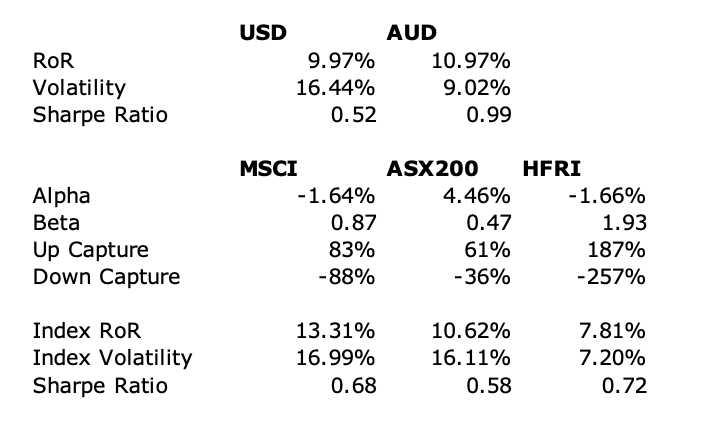
The top three lines give our performance in USD and AUD terms, while the last three lines give the same statistics for three indices. The middle block gives our performance relative to the indices. Our rate of return remained higher than the ASX200 despite such a disastrous month and we have much lower volatility, resulting in a Sharpe ratio of 0.99 vs. 0.58. Our alpha relative to the ASX200 fell to 4.46% (from 4.94%) with a beta of only 0.47. We capture much less of the downside moves than the upside moves in the market. But as we optimize for Australian Dollar performance, our USD statistics are much worse. We do beat the HFRI hedge fund index in terms of return, but at the expense of much higher volatility. Our USD volatility is at least less than that of the MSCI index, but our return is more than three percentage points lower.

We moved towards our target allocation due to the poor performance of the overweighted asset classes, which previously had performed well. Our actual allocation currently looks like this:


About 70% of our portfolio is in what are often considered to be alternative assets: real estate, art, hedge funds, private equity, gold, and futures. A lot of these are listed investments or investments with daily, monthly, or quarterly liquidity, so our portfolio is not as illiquid as you might think.

We receive employer superannuation contributions every two weeks. We contribute USD 10k each quarter to the Unpopular Ventures Rolling Fund and less frequently there will be capital calls from Aura Venture Fund II. I am now receiving TTR pension payments from both Unisuper and our SMSF and contributing more than the total of these to the SMSF (around AUD 4k net contribution per month). I made the following additional moves this month:

  • I sold 10k shares of Hearts and Minds (HM1.AX) as it neared the after tax NAV.
  • With the proceeds I bought 3k shares of WCM Global (WCMQ.AX), which is a global stock actively managed ETF.
  • I also bought another 100 shares of FBTC, Fidelity's bitcoin ETF. 
  • I did a follow on investment of USD 2,500 in Chowdeck, a Nigerian food delivery app. This is their Series A investment round. Previously, I invested in the seed round at a lower valuation.

Saturday, December 28, 2024

Who to Follow on Crypto?

I've managed to build some confidence in investing in bitcoin and the larger crypto ecosystem by following a few key people:

Oscar Carboni: Technical analyst and futures trader. His analysis of bitcoin prompted me to first get into bitcoin.

Didi Taihuttu: Digital nomad who went all in on bitcoin after previously mining bitcoin. Very skilled at technical analysis of bitcoin.

Anthony Pompliano: Entrepreneur in crypto space. He sold his company Reflexivity Research to Defi Technologies. His analysis of DEFI.NE prompted me to invest.

Raoul Pal: Former hedge fund manager who provides macro-investing services as well as crypto commentary. He links crypto trends to broader macro and especially "liquidity".

Saturday, June 08, 2024

Cambria Funds Launches a New Managed Futures ETF: How Will it Perform?

Cambria Funds have launched a new managed futures ETF – MFUT – managed by Chesapeake - Jerry Parker's (one of the turtle traders) firm. I compared the historic performance of the Chesapeake Diversified Plus managed futures program to the Winton Global Alpha Fund since 1996:


Clearly, Winton has outperformed Chesapeake and with substantially less volatility. The average return of Chesapeake has been 11.6% p.a., while Winton achieved 15.0%. Chesapeake's information ratio (Sharpe ratio with a zero percent hurdle) was only 0.44, while Winton's was 0.96.

It seems that Chesapeake's volatility decreased after about 2012. So let's focus on the period since then. Since the beginning of 2012 Chesapeake has outperformed Winton with an average annual return of 8.8% vs. 7.3%. However, Winton was still less volatile with an information ratio of 0.77 vs. Chesapeake's 0.52.

The full period, the correlation between the monthly returns of the two funds was only 0.44. Since 2012 it was 0.54. So, there it would seem there is a potential diversification case for investing in both funds. However the information ratio of an equal weight combination of the two funds is lower than that of Winton alone. This is true for both the full period and the post 2011 period. So, based on this, I won't be investing in MFUT.

Sunday, May 26, 2024

SMSF Portfolio Allocation

As there has been a lot of recent change in the SMSF portfolio allocation, I thought I would have a detailed look at it. The last time I updated this spreadsheet was in August 2022, when the portfolio was quite different.

We also are long two Australian Dollar futures contracts. The asset classes are where each investment is classified for my reporting based on asset classes. PBDC is equity of private credit lenders, Defi Technologies is a crypto asset manager, and bitcoin isn't mostly actually futures. So, their designated asset classes are a bit to a lot misleading. Regal is actually only about 50% hedge funds now, with real assets (water and royalties), private credit, and venture capital in the mix. In my reporting on asset classes I break it down along these lines.

So there is about 30% managed futures exposure, 21% crypto exposure, about 17% private equity, 16% property, 15% hedge fund with some real assets thrown in, and 1% cash.

There wouldn't be much point in having an SMSF if the portfolio looked like a typical industry fund 😊. 

We pay only 0.26% per year in admin fees to SuperGuardian.


Friday, April 12, 2024

APSEC Update

I invested in the APSEC hedge fund back in 2020 just after they outperformed strongly in the COVID19 crash. They have managed to about match the ASX 200 over time with somewhat lower volatility:

They tend to outperform in bear markets and under-perform in bull markets. Since investing, I have only gotten a 5.9% internal rate of return, which is below average. The median IRR of my current investments is 9%. I would have done better by investing more in the Aspect Diversified Futures Fund instead, which has similar hedging properties, where I have had a 22% IRR. We have 2.47% of net worth in the fund all of it within the SMSF. I submitted a redemption notice for all of our holding today.


Tuesday, February 20, 2024

When Does Our Investment Strategy Add Value?

EnoughWealth wonders if our investment strategy only adds value under certain market conditions. As a first step let's look at when the out-performance relative to the 60/40 portfolio happened:


The graph simply takes away the monthly return on the Vanguard 60/40 portfolio from Moom's actual results. We see there are periods of out- and under-performance throughout the period. Not surprisingly, it was weaker in 2023 in particular. I didn't do well in implementing the target portfolio strategy last year. Here is a graph comparing the performance of this theoretical portfolio and the Vanguard portfolio:


This looks more consistent. This portfolio is theoretical because it consists of a mix of actual investible funds and non-investible indices.

Bottom line, is I think it is a good idea to add things like managed futures, gold, real estate etc to your portfolio. It makes a real difference.

Saturday, February 10, 2024

Updating Target Asset Allocation


Not sure when I last posted about our target asset allocation, as I have tweaked it since this 2021 post. I am tweaking it again to reflect continuing new allocations to private equity (venture capital, buyout funds, and SPACs).

Overall we still have a 60% equity allocation. Now 20% of that will be the target for private equity, 20% hedge funds, and 20% long equity. Among the latter, 11% allocated to Australia and 9% to foreign shares. Within Australia, 6% is allocated to large cap and 5% to small cap. Within foreign equity, 5% to the US and 4% to the rest of the world. 

Among the 40% allocated to other assets, 15% is allocated to real assets including real estate, art, water rights etc., 5% to bonds (including private credit), 10% to managed futures, 10% to gold.

The benchmark target portfolio splits the private equity component 50/50 between venture capital and buyout. It also allocates all the Australian exposure to the ASX200 and all the real asset allocation to a specific (mainly US) real estate fund. All the managed futures is allocated to Winton in the benchmark. Maybe I should try harder on this benchmark, but this seems good enough for my purposes.

Monday, January 08, 2024

Contributions to Annual Return

I haven't formally finalized the accounts for 2023 yet. I will need to wait to get investment returns on illiquid investments that report with a long time lag. But I do have a preliminary estimate of 6.38% in AUD terms (6.64% in USD terms). This is rather disappointing as the MSCI returned 22.81%, the S&P 500 26.27%, and the ASX 200 14.45%. Our target portfolio returned 10.84%. So, why did we underperform the target by so much? The following tables analyze the returns of each portfolio:

RoR is the rate of return of the asset class and contribution is the rate of return multiplied by the share of the portfolio. The sum of contributions gives the portfolio return. The returns for the Moom portfolio are in currency neutral and unlevered terms and, so, differ slightly from the Australian Dollar return for the portfolio. The asset classes don't quite match, but it's close enough. 

The target portfolio got 2.48% returns from international stocks. The return I got from US stocks at 15.8% was less than the MSCI index at 22.5% but more importantly, my allocation to other countries resulted in a negative return and so the total contribution from international stocks was only 0.89%. 

The target portfolio got 1.73% returns from Australian stocks. Again, my return from Australian large caps was a bit lower than that of the ASX 200 but my allocation to small cap stocks had a negative return and so the overall contribution was only 0.49%.

The target portfolio represents managed futures using the Winton Global Alpha Fund. This gave a contribution of 0.59%. I also allocated to the Aspect Diversified Futures Fund and Australian Dollar futures. These dragged down returns resulting in a contribution of only 0.18%.

The target portfolio obtained a 1.61% contribution from hedge funds (based on the HFRI index), while I only got 0.25%. Though some funds like Pershing Square did very well, other Australian hedge funds under-performed.

Real Assets is the area where I outperformed. I represent this in the target portfolio using the TIAA Real Estate Fund. My allocations to other real assets resulted here in a small gain rather than a large loss.

Bonds and gold made a similar contribution to each portfolio. Finally, venture capital made an outsized contribution to the target portfolio of 4.38%. My venture capital investments lost money overall in 2023. I did much better than the target portfolio in buyout investments like 3i. But this wasn't sufficient to match the target portfolio's overall private equity contribution.

I think there is some luck here. In a different year, non-US stocks or Australian small caps might perform well. On the other hand, I also need to eventually reduce some of my allocations to Australian hedge funds that have under-delivered.


Sunday, April 09, 2023

March 2023 Report

In March, stock markets rebounded. The MSCI World Index (USD gross) rose 3.15% and the S&P 500 3.67% in USD terms, while the ASX 200 only gained 0.25% in AUD terms. All these are total returns including dividends. The Australian Dollar fell from USD 0.6740 to USD 0.6695. We gained 0.55% in Australian Dollar terms but lost 0.15% in US Dollar terms. The target portfolio gained 1.84% in Australian Dollar terms and the HFRI hedge fund index is expected to gain 1.47% in US Dollar terms. So, we only out-performed the ASX200.

Here is a report on the performance of investments by asset class:

The asset class returns are in currency neutral returns as the rate of return on gross assets. I then add in the contributions of leverage and other costs and the Australian Dollar to the AUD net worth return. We underperformed the target portfolio benchmark because of negative returns on international stocks and hedge funds as well as negative returns on Australian small caps. We lost on US stocks because of a very negative return from Hearts and Minds (HM1.AX) offsetting positive returns on other US holdings.

Gold was the main positive contributor to returns and the highest returning asset class while futures were the largest detractor and worst performing asset class. The trend-following managed futures funds got caught in the sudden movement in US bonds during the month associated with the banking crisis.

Things that worked well this month:

  • Gold gained AUD 54k - the biggest monthly gain in a single investment since I started investing.

What really didn't work: 

  • Tribeca Global Resources (TGF.AX) lost AUD 11k. Followers up were: Pershing Square Holdings (PSH.L, -10k), Aspect Diversified Futures (-9k), Hearts and Minds (HM1.AX, -9k), and Winton Global Alpha (-8k).

The investment performance statistics for the last five years are: 

The first three rows are our unadjusted performance numbers in US and Australian dollar terms. The MSCI is reported in USD terms. The following four lines compare performance against each of the three indices over the last 60 months. The final three rows report the performance of the three indices themselves. We show the desired asymmetric capture, positive alpha, and higher Sharpe Ratio against the ASX200 but not the USD benchmarks. We are performing about 3.6% per annum worse than the average hedge fund levered 1.76 times. Hedge funds have been doing well in recently.

We are now very close to our target allocation but we mived away from it quite sharply during the month. In particular, real assets increased as we added to URF.AX and it rose, while private equity fell as we took profits in PE1.AX. Our actual allocation currently looks like this:

About 70% of our portfolio is in what are often considered to be alternative assets: real estate, art, hedge funds, private equity, gold, and futures. A lot of these are listed investments or investments with daily, monthly, or quarterly liquidity, so our portfolio is not as illiquid as you might think.

We receive employer contributions to superannuation every two weeks. We are now contributing USD 10k each quarter to Unpopular Ventures Rolling Fund and less frequently there will be capital calls from Aura Venture Fund II. In addition, we made the following investment moves this month:

  • I sold 100 China Fund (CHN) shares.
  • I sold 3,500 WAM Leaders (WLE.AX) shares.
  • I sold 10k MCP Income Opportunities (MOT.AX) when the price spiked back up to AUD 2.10.
  • I bought 12k shares net of Cordish-Dixon Private Equity Fund 3 (CD3.AX).
  • I did a losing trade in bond futures.

Sunday, March 05, 2023

February 2022 Report

In February, stock markets fell again. The MSCI World Index (USD gross) fell 2.83% and the S&P 500 2.44% in USD terms, while the ASX 200 lost 2.25% in AUD terms. All these are total returns including dividends. The Australian Dollar fell from USD 0.7113 to USD 0.6740. We also lost money: 0.47% in Australian Dollar terms or 5.69% in US Dollar terms. The target portfolio gained 0.72% in Australian Dollar terms and the HFRI hedge fund index is expected to lose about 0.83% in US Dollar terms. So, we out-performed the ASX200 but under-performed all the other benchmarks.

Here is a report on the performance of investments by asset class:

The asset class returns are in currency neutral returns as the rate of return on gross assets. I then add in the contributions of leverage and other costs and the Australian Dollar to the AUD net worth return. One reason that we underperformed the target portfolio benchmark is the very negative returns we got for rest of world stocks and to a lesser degree hedge funds. The Australian Dollar cash price of gold was breakeven for the month, so I also don't understand why PMGOLD.AX lost value, especially as I bought some extra shares during the month at a price that was lower than the end of month price...

Real assets were the main positive contributor to returns and the highest returning asset class while hedge funds were the largest detractor.

Things that worked well this month:

  • URF.AX (US residential real estate) was the biggest gainer adding AUD 11k, followed by two managed futures funds: Winton Global Alpha (9k) and Aspect Diversified Futures (6k).

What really didn't work: 

  • Tribeca Global Resources (TGF.AX) lost AUD 30k. The next worse were the China Fund (CHN, -19k) and Australian Dollar Futures (-15k).

The investment performance statistics for the last five years are: 

The first three rows are our unadjusted performance numbers in US and Australian dollar terms. The MSCI is reported in USD terms. The following four lines compare performance against each of the three indices over the last 60 months. The final three rows report the performance of the three indices themselves. We show the desired asymmetric capture, positive alpha, and higher Sharpe Ratio against the ASX200 but not the USD benchmarks. We are performing about 3.3% per annum worse than the average hedge fund levered 1.77 times. Hedge funds have been doing well in recently.

We are now very close to our target allocation but we mived away from it quite sharply during the month. In particular, real assets increased as we added to URF.AX and it rose, while private equity fell as we took profits in PE1.AX. Our actual allocation currently looks like this:


About 70% of our portfolio is in what are often considered to be alternative assets: real estate, art, hedge funds, private equity, gold, and futures. A lot of these are listed investments or investments with daily, monthly, or quarterly liquidity, so our portfolio is not as illiquid as you might think.

We receive employer contributions to superannuation every two weeks. We are now contributing USD 10k each quarter to Unpopular Ventures Rolling Fund and less frequently there will be capital calls from Aura Venture Fund II. In addition, we made the following investment moves this month:

  • I bought 1,000 shares of the gold ETF, PMGOLD.AX.
  • I sold 4,000 shares of WAM Leaders (WLE.AX).
  • I sold 59,976 shares of Pengana Private Equity (PE1.AX).
  • I bought 29,638 shares of the Cordish-Dixon private equity fund CD3.AX.
  • I bought 25,000 shares of MCP Income Opportunities private credit fund (MOT.AX).
  • I bought 65,000 shares of URF.AX (US residential real estate).

Wednesday, March 01, 2023

January 2022 Report

In January, stock markets rebounded. The MSCI World Index (USD gross) gained 7.19% and the S&P 500 6.28% in USD terms, and the ASX 200 gained 6.23% in AUD terms. All these are total returns including dividends. The Australian Dollar rose from USD 0.6816 to USD 0.7113. We gained 2.21% in Australian Dollar terms or 6.66% in US Dollar terms. The target portfolio rose 1.45% in Australian Dollar terms and the HFRI hedge fund index around 2.8% in US Dollar terms. So, we out-performed the S&P 500, the HFRI, and our target portfolio and under-performed the others.

Here is a report on the performance of investments by asset class:

The asset class returns are in currency neutral returns as the rate of return on gross assets. I have added in the contributions of leverage and other costs and the Australian Dollar to the AUD net worth return.

All asset classes had positive returns. Private equity was the largest contributor to returns Followed by hedge funds, while RoW stocks had the highest return.

Things that worked well this month:

  • 3i (III.L) rose strongly, gaining AUD 22k. Tribeca (TGF.AX 18k), Unisuper (15k), PSSAP (14k), China Fund (CHN, 13k), and Hearts and Minds (HM1, 10k) all contributed more than AUD 10k.

What really didn't work: 

  • Three managed futures funds all lost money, with Winton Global Alpha losing the most (AUD 4k).

The investment performance statistics for the last five years are: 

The first three rows are our unadjusted performance numbers in US and Australian dollar terms. The MSCI is reported in USD terms. The following four lines compare performance against each of the three indices over the last 60 months. The final three rows report the performance of the three indices themselves. We show the desired asymmetric capture and positive alpha against the ASX200 and the MSCI but not against the hedge fund index. We have a higher Sharpe Index than the ASX200 but lower than the MSCI in USD terms. We are performing about 2.6% per annum worse than the average hedge fund levered 1.75 times. Hedge funds have been doing well in recently.

We are now very close to our target allocation. Our actual allocation currently looks like this:

About 70% of our portfolio is in what are often considered to be alternative assets: real estate, art, hedge funds, private equity, gold, and futures. A lot of these are listed investments or investments with daily, monthly, or quarterly liquidity, so our portfolio is not as illiquid as you might think.

We receive employer contributions to superannuation every two weeks. We are now contributing USD 10k each quarter to Unpopular Ventures Rolling Fund and less frequently there will be capital calls from Aura Venture Fund II. In addition, we made the following investment moves this month:

  • I bought 1,000 shares of the China Fund, CHN.
  • I bought 3,000 shares of Ruffer Investment Company, RICA.L.